AI World Builder: What a World Has to Hold

An AI world builder is only useful if the world survives contact with a story. What it generates, four things to test, and where generated worlds fall apart.


What the builder actually produces
Describe a world in one sentence — a franchise you already know, or something original like a city powered by captured storms — and the builder returns a structured set: characters with backstories and relationships, locations with descriptions, events on a timeline, factions with goals and rivalries, and lore entries that tie the rest together. Every one of those arrives as an editable card, not as a paragraph of prose, which is the difference between a text generator and a world.
It also builds the art direction: covers, character art, location visuals, maps and cinematic stills generated in a single palette so the pieces look like they belong to the same place. Then it publishes the whole set as a living canvas in the browser, and you can open it, share it, or fork a public world and rewrite it. That is the honest scope. It is not a game engine, and it does not hand you a walkable 3D level — a separate builder does that.
| Input | One sentence, franchise or original |
| Output | Characters, locations, events, factions, lore |
| Also generated | Covers, maps, art direction |
| Published as | A living canvas you can fork |
Name the place, not the genre
Give the builder a place and a problem that exists there. The world-builder skill fills in the people, the factions and the map, then keeps the palette consistent across every card it makes.
The four things worth testing
A generated world can look impressive on the first screen and collapse the moment you try to set a scene in it. These four checks separate a world you can write in from a wall of pretty cards.
- One geography — Can you point at where things are? If the locations have no relationship to each other — no distance, no border, no trade route — you have a gallery, not a world. A map that answers “how far” is the cheapest test.
- Factions that want different things — Two groups with incompatible goals generate plot by themselves. Ten groups with the same goal generate a list. Read the faction cards and check whether any two of them would argue.
- A rule that costs something — Magic systems, technology, law: a world needs one constraint that makes some actions expensive. If everything is possible, nothing is at stake, and the lore is decoration.
- A palette that holds — Open the covers side by side. If the character art and the map could have come from different projects, the art direction failed — and the world will feel assembled rather than found.
- A place you would set a scene — Pick one location card and try to write the first line of a story there. If nothing suggests itself, the description is a label. The entries worth keeping usually contain one physical detail you did not ask for.
Franchise or original: two different jobs
Name an existing franchise and the builder has to reproduce a shape people already know — the houses, the districts, the factions — and the value is coverage and consistency rather than surprise. Describe an original world and it has to invent the relationships, which is harder and usually more interesting. The practical difference: a franchise world is judged against canon and will always be a fan work, while an original world only has to be internally consistent. If you plan to publish and keep building, start original; the constraint that everything has to agree with itself is a better teacher than accuracy.


Worlds built this way
Real published worlds, not mockups: two franchise atlases, one franchise portal, two original settings and a star map that scales the same structure across sixteen worlds.



The atlas is the proof
The Pokémon nine-region atlas is the clearest demonstration: a world with a geography you can click through, where each region has a reason to be where it is. The Wizarding World Atlas does the same with fewer places and more text, and the Koprulu Sector star map shows the structure holding at sixteen locations — the point where a list would normally become unusable.
When the world is yours
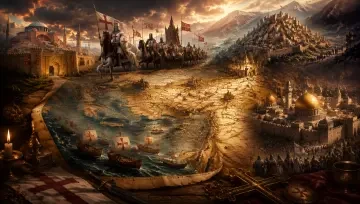
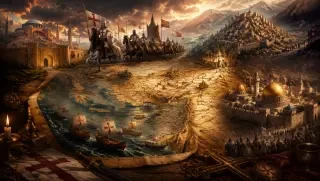
Flames of the Levant is an original setting built from one prompt: a coast, a set of cities, and borders with reasons. Rome World Archive takes a historical world and treats it as a bible, where factions and dates are allowed to disagree. Both are more useful as writing references than any franchise recreation, because nothing in them is protected by canon.
Three steps from a sentence to a world
Write the sentence with a problem in it
“A harbour city that trades in remembered weather” gives the builder a place, an economy and a rule. “A fantasy world” gives it a mood board. The problem is what generates factions.
Check the map before the prose
Open the layout first. If you cannot say how far two locations are from each other, fix the geography before you write a single character. Everything downstream inherits it.
Fork what works and rewrite the rest
Start from a public world close to your idea, then replace the parts that do not fit. One prompt gets you a first draft; the second pass is where the world becomes yours.
Six worlds to open






One sentence is enough to start
Open the world builder, describe a place and a problem, and let it populate the rest. If you want to see what the same cards look like once a story is running inside them, the roleplay hub is one click away.
Built with the world-builder skill
Three named skills do the work here. world-builder runs the whole pass: characters, locations, events, factions, lore and art direction as linked cards, published as a canvas, with the map drawn from the same location entries. character-sheet fixes the people who live there, so the cast keeps one face and one silhouette across every card, and image produces the stills that sit beside them. If a world needs a walkable scene rather than a canvas, that is the 3D builder, a different tool with a different output.
FAQ
What does an AI world builder actually make?
A structured set of cards: characters, locations, events, factions and lore entries, plus generated art for each and a consistent art direction. They are published together as a canvas you can browse and edit, and you can fork a public world to start from someone else’s structure.
Can I build a world from a franchise I love?
Yes. Name the franchise and the builder produces a fan world with its factions, places and cast. It is an interpretation, not official material, and it will not reproduce protected artwork — treat it as a fan work that you can keep building on.
Does it make a playable 3D world?
Not this tool. The output is a living canvas of cards and an interactive map, not a walkable level. If you want to walk around inside the place, that is the 3D world builder, which is a separate product with a different output.
How is this different from asking a chatbot for lore?
A chatbot returns paragraphs and forgets them at the end of the conversation. This returns linked entries with covers and a map, stored as a world you can reopen, edit, publish and fork. The structure is the product.
What should I check before I trust a generated world?
Four things: whether locations relate to each other geographically, whether any two factions want incompatible things, whether one rule makes some actions expensive, and whether the covers share a palette. Worlds usually fail on the second one.
Is it free to start?
You can build and publish a world without paying. Larger worlds and heavy image generation are where any tool like this eventually asks for something, so plan the first pass around one region rather than a continent.
Keep reading
Platform: Neta Studio · Type: Tool · AI world builder · Hub: neta.art/app/agent-skills · Works: Pokémon · nine regions · Jujutsu Kaisen portal · Wizarding World Atlas · Flames of the Levant · Koprulu Sector · Rome World Archive
