Blixer (Just Shapes & Beats): The Boss, Explained

“Blixer” is a fan name for the Boss in Just Shapes & Beats — a pink cat-eared outline that corrupts the Tree of Life. Its story, forms and ending, sourced.


First, the name problem
The character does not officially have a name. In-game, the HP bar during “Till It’s Over” calls it BOSS. The official Discord uses the emote JSB_Boss. The internal files call it BOSS. A PlayStation 4 avatar lists it as “Boss”, with a crowned variant named “New Game”. The wiki’s page title is explicitly marked conjectural. “Blixer” is a fan nickname with no confirmed meaning — a second, less common one is “Fresh”, after its debut level, Long Live The New Fresh.
That is worth saying plainly rather than inventing a canon. What the character does have is a complete design history and a very clean dramatic arc: it is the main antagonist of Just Shapes & Beats, it corrupts the Tree of Life, it splits the tree into three pieces, and it ends the story doing the lighting in the credits. Everything below comes from the game and its wiki, and where the record is a nickname rather than an official name, the page says so.
| Name | “Blixer” — fan nickname. In-game it is only BOSS |
| Game | Just Shapes & Beats (Berzerk Studio), Story Mode |
| Role | Main antagonist; corrupts the Tree of Life |
| First seen | Long Live The New Fresh |
Fight something that has no face
A boss made of an outline is a boss you cannot read. The roleplay skill can put you in a room with an antagonist that communicates only through shapes, timing and a soundtrack.
The look, and who actually drew it
Nearly everything about the design is subtraction. It is an outline with no fill, in the same harmful pink the game uses for every obstacle — so the player reads “danger” before they read “character”. What looks like a horn is, according to the game’s artist, an ear.
- Outline, not silhouette — The Boss is drawn the way every hazard in the game is drawn: pink line, no interior. It belongs to the language of obstacles before it belongs to the cast.
- Cat, not demon — The artist Em has said she designed it as a cat, and that the triangles above the head are cat ears that read as horns. The hands resemble paws. It is meant to be cute, which is why it is unsettling.
- The crown is the plot — A crown built around a piece of the Tree of Life is how the character declares itself king — and the same crown is what the player wears to purify the last piece.
- The final form is a shape change — It impales its own head with the last tree piece. The head becomes a nonagon, the eyes go black with pink dots, and the outline starts to bleed. The design language escalates by becoming more geometric, not more detailed.
Three scenes that carry the character
1. The first plant.
A shape slams into the triangle you were told to follow. For one beat nothing happens. Then it unfolds into an arm, and the arm has a hand, and the hand is already reaching for you.
2. The crown.
You have just put on the crown and turned the last piece of the tree blue. Something behind you inhales. You have time to turn around once.
3. The credits.
The world is restored, the music is warm, and the thing that tried to end it is in the corner with headphones on, doing the lights. Neither of you says anything.
In the story: a rampage in five movements
It arrives disguised as a plant that slams into the triangle the player is following, then unfolds into an arm. It rampages out of the cavern, chases the player and the Big Cube, punches a friendly plant on the way, and fires a laser from its eye that damages the game’s own opening credits text. Then it pulls the Tree of Life out of the ground and corrupts it, and the Tower rises. From there it is a study in escalation: it eats the triangles it pours out to take its empowered form, crowns itself with a piece of the tree, slams another piece into a volcano to turn it pink, and spends the Tower chapter on top of a stack of speakers, playing its own theme on a pink guitar while lightning hits around it. The player wins, wears the crown, and starts purifying the last piece — and the Boss comes back, turns its mouth into a horn, blows the player away, and impales its own head with the final triangle rather than lose it.


Play the boss-shaped games
These are real works on Neta Studio. Each one is built on the same lesson: an antagonist is a pattern the player has to learn, not a health bar with a speech.



Towers and patterns
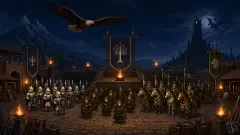
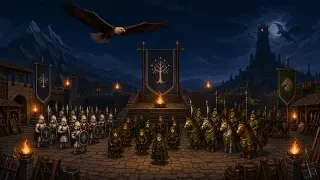
Kül Kulesi (Ashspire) is a pixel roguelite where the tower grows as you climb, which is the Tower chapter rebuilt from the other side. Pixel Middle-earth Barracks turns pressure into a board that fills up faster than you can clear it — the same lesson with tiles instead of spikes.
One mechanic, pushed
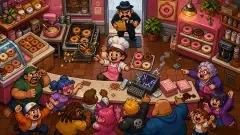
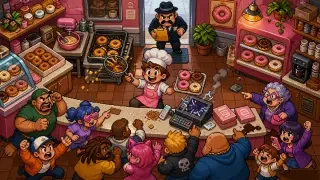
Teto Baguette Bounce is a charge-and-bounce arcade tuned until the joke becomes difficult. FRY HARD — Donut Shop Panic puts the whole fight on a timer, and Dragon Girl: Fruit Frenzy treats the difficulty curve itself as the antagonist.
How to play a silent antagonist
Give it one tell
The Boss has a single readable signal: pink outline means harm. One consistent tell is worth more than a personality, because the player has to learn it under pressure.
Let it take something
It does not want to kill the player; it wants the tree. A villain with an object is easier to stage than a villain with a grudge.
End it in the credits
The Boss returns in the end credits in its first form, with headphones and a DJ set. A quiet epilogue does more than a final monologue.
The worlds, briefly






Some antagonists should never speak
The Boss has no dialogue, no motive speech and no name in the credits. It is still the most memorable thing in the game, because the design carries the argument. Neta runs stories where the antagonist is a rule rather than a speech.
Built with the roleplay skill
roleplay keeps the arena, the clock and the pattern, so a wordless antagonist can be played as pressure instead of dialogue; game turns the encounter into something with a win condition. Images here are original abstract work — no official art is reproduced, and this page is not affiliated with Berzerk Studio.
Blixer / Just Shapes & Beats FAQ
Is “Blixer” the character’s real name?
No. It is a fan nickname with no confirmed meaning. The game only ever calls it BOSS — in the HP bar, the internal files and the PS4 avatar — and the wiki marks the page title as conjectural.
What is the Boss in Just Shapes & Beats?
The main antagonist of Story Mode: a pink outlined entity that corrupts the Tree of Life, splits it into three pieces, builds the Tower, and fights the player across Long Live The New Fresh, New Game, Final Boss and Annihilate.
Is it a cat or a demon?
A cat, by the artist’s account. Em has said the triangles above the head are cat ears that get mistaken for horns, and that the hands resemble paws.
Why does it have no fill?
Because the game draws every hazard as a pink outline. Giving the antagonist the same visual language as an obstacle is the design decision that makes it read as danger before it reads as a character.
How does the story end for the Boss?
The player wears its crown and purifies the last tree piece; the Boss returns, blows the player away, and impales its own head with the final triangle. After the final fight it reappears in the credits in its original form, wearing headphones and working a DJ set.
Is this an official page?
No. It is a fan-made character page on Neta Studio, unaffiliated with Berzerk Studio, illustrated with original abstract art rather than screenshots.
Keep reading
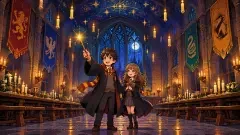
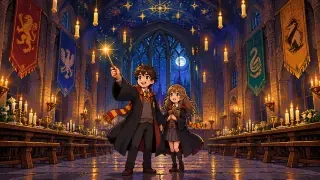
Platform: Neta Studio · Type: Just Shapes & Beats Character · Hub: neta.art/app/roleplay · Works: Kül Kulesi (Ashspire) · Pixel Middle-earth Barracks · Teto Baguette Bounce · FRY HARD — Donut Shop Panic · Dragon Girl: Fruit Frenzy · Hogwarts: Pixel Spell Brawl