
AI entertainment needs a missing middle.
AI interactive entertainment is often described as the next platform shift — some call it 100× gaming. If that is even half right, the industry will not organize as a single product category. It will organize as a stack of layers, each answering a different question. This essay maps the five layers of AI interactive entertainment — and argues that the two in the middle, world materials and creation protocols, are where durable value will be created.
01 · The premise: start with the size of the system
Imagine interactive content that no longer requires a studio, a fixed game engine, or even a finished product. Anyone can generate a world, publish an experience, and let other people extend it.
If that market is truly 100× gaming, what kind of ecosystem could support it? Three comparisons frame the gap:
- Reach. Gaming reaches roughly three billion players. Interactive media can reach people who would never call themselves gamers.
- Creation. Games require professional teams. Generative tools turn many more people into world creators.
- Economy. Games monetize finished titles and in-app economies. AI entertainment can behave more like a creator network.
A market this large cannot remain a single product category. The work will separate into distinct problems, companies, and economic roles. The useful question is not "who wins AI entertainment?" but "where does each kind of value get created?"
02 · The framework: five layers, segmented by problem — not by technology
Traditional software boundaries — frontend, backend, database — blur when generation happens at runtime. A more durable map begins with the question each layer must answer.
L1 · Inference & infrastructure
How fast and cheaply can a world run?
L2 · World generation & runtime
How is the world generated and executed in real time?
L3 · World materials & shared state
What survives after a session ends?
L4 · Creation & update protocols
How do worlds compose, fork, merge, and co-evolve?
L5 · Experience, distribution & economy
Who participates, how does it spread, and how does money flow?
L2 and L5 are already crowded. L3 and L4 are the missing middle.
Three shifts make this segmentation necessary: generation is runtime; state is both data and reusable asset; and creation protocols must cross assets, permissions, lineage, and economics at once.
03 · The missing object: a generated world needs a form it can persist in
When a conversation ends or a world-generation session closes, what remains? A transcript is not a world. A save file is not yet a reusable creative system.
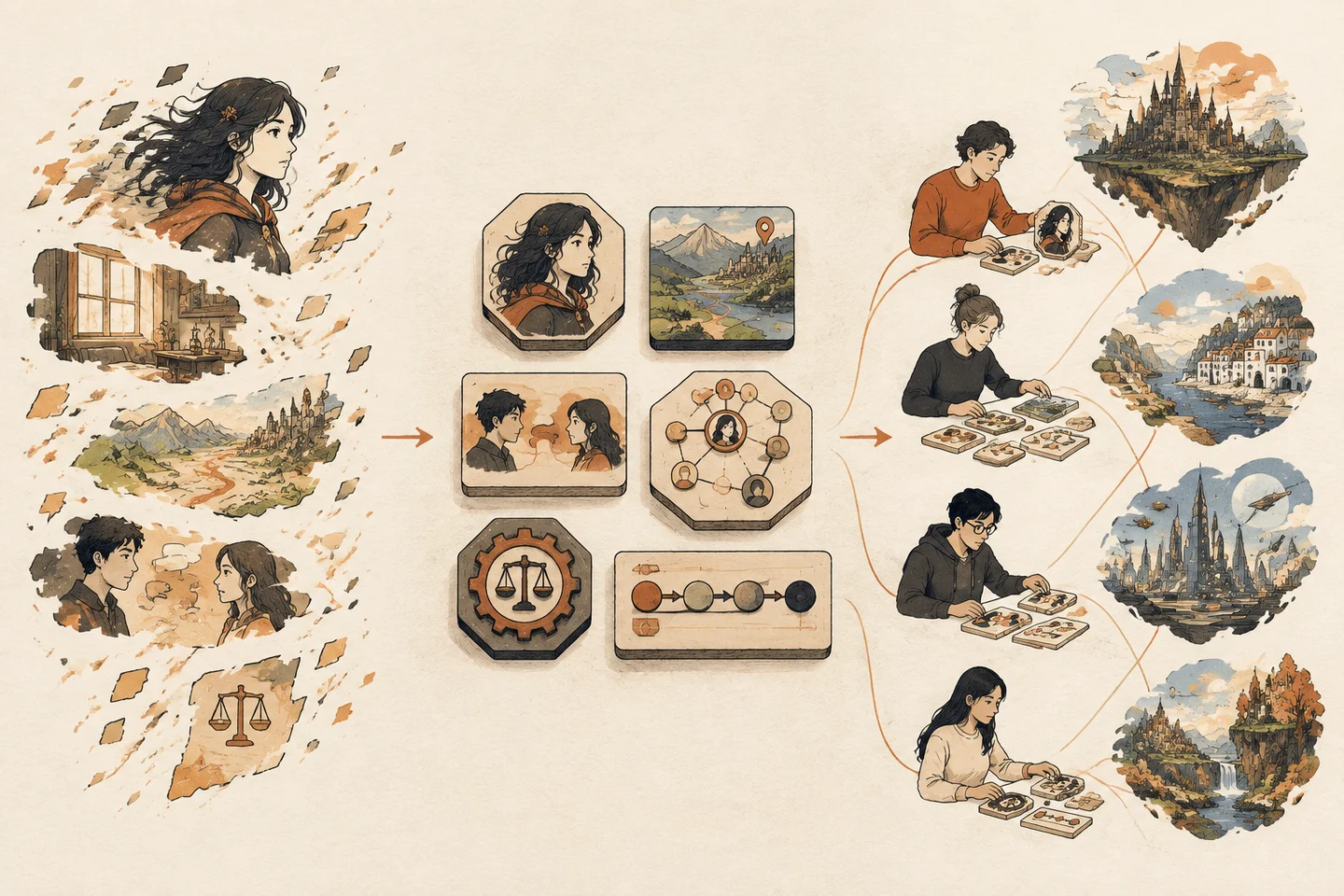
Figure 01 — Runtime fragments become durable materials; durable materials make remix, inheritance, and lineage possible.
What persists takes three forms:
Encoded materials
Characters, locations, props, rules, plot fragments, dialogue patterns, and event triggers.
Shared state
World history, player traces, relationships, market conditions, unlocked paths, and consequences.
Creative capacity
Prompts, skills, plugins, and workflows that reliably produce more of the world.
Without L3, every generation starts over. With L3, worlds can accumulate.
This is the boundary between one-off generation and a persistent world: not whether something can be created, but whether its identity, rules, and history can be inherited by the next act of creation.
04 · The critical gap: the middle layers decide whether the edges compound
The layers pull on each other in both directions.
Forward dependency: generation gives L3 something to crystallize. Materials give L4 something to coordinate. Protocols give L5 a record of contribution and value to reward.
Reverse pull: willingness to pay at L5 defines the commercial value of protocols, while collaboration needs at L4 define what a world material must contain.
L2 determines whether worlds can be created. L3/L4 determines whether they persist. L5 determines whether creators can sustain them.
Character.AI and PolyBuzz show the ceiling
Product | ARPU | Scale | Signal |
|---|---|---|---|
Character.AI | $0.09 | 31M MAU · unprofitable | The ceiling of transient chat |
PolyBuzz | $0.33 | 6M MAU | Better incentives, same transient core |
PolyBuzz monetizes better, but both products still center on the transient. Characters do not easily compose into larger worlds; creators cannot fork and trace lineage; and reuse never becomes a durable revenue event.
The deeper claim is structural: L5 can optimize distribution and tipping, but its economic ceiling remains tied to the depth of L3 and L4.
05 · Precedents: every layer has been solved somewhere else
The pieces are not unprecedented. What is new is their convergence around generated, persistent worlds.
Layer | Precedent | What it proved |
|---|---|---|
L1 · Inference | NVIDIA / Reactor | Scale compute and optimize inference. |
L2 · Generation & runtime | World Labs / Mora / Genie | Push quality, coherence, physics, and latency. |
L3 · World materials | MakerWorld | Turn finished objects into a remixable asset network. |
L4 · Creation protocols | GitHub | Make contribution, forking, merging, and lineage legible. |
L5 · Distribution & economy | YouTube | Join distribution, creator incentives, and revenue sharing. |
06 · The closest precedent: Roblox covered most of the stack — and exposed its limits
Roblox is the strongest prior-generation example because it connected an engine, asset marketplace, collaboration tools, distribution, and creator revenue. Its weaknesses point directly toward the next opening.
What Roblox proved
- Assets and economic participation reinforce retention.
- Creation tools become more valuable when distribution is built in.
- A world platform can span multiple layers.
What remains open
- Protocols that are not locked to one engine.
- Real fork and lineage across world materials.
- Revenue attribution based on inherited contribution.
07 · Strategic position: the framework changes who counts as a competitor
L2 generation companies and L4 protocol companies are not natural substitutes. They can have a supply relationship, much as an engine and a code-collaboration layer solve adjacent problems.
Position one: build L2
Compete on world quality, controllability, coherence, latency, and cost.
Position two: build L3 + L4
Define what persists, how it composes, and how contribution remains traceable.
Position three: build L5
Compete on audience, discovery, retention, safety, and monetization.
The missing middle is the opportunity
The largest opportunity may not be generating another world. It may be giving worlds something to become.
If AI interactive entertainment reaches the scale implied by the 100× thesis, specialized model companies will keep advancing L2 and consumer products will keep fighting for L5. But durable creator economics requires a missing middle: reusable world materials, shared state, open creation protocols, and legible lineage.
Neta Studio is building in that middle. Live World Memory — one world, many live apps, one shared state — is our L3 answer in product form. Read how it works in What Makes an AI World Feel Alive?.
- Start building your own world: neta.art
- Explore worlds made by others: neta.art/explore
- See what creators are already building: 10 real use cases