
One world, many live apps, one shared state.
Some AI conversations feel disposable. You close the window, and nothing pulls you back. Others begin to feel like places: you return because something happened there, and you expect it to still matter. The difference is not model quality — it is whether the world remembers. That shared act of remembering is what we call Live World Memory, and this essay is about the structure beneath it.
A character remembering one conversation is useful. A world carrying what happened across all of its forms is something else.
Memory in one chat is not world memory
Most AI products remember inside a single feature. Chat history belongs to chat. Character settings belong to a character page. Locations belong to a map. Each surface may work well on its own, but the experience ends at its boundary.
You can build trust with a character in conversation, then open the map and find no trace of it. You can discover a place during roleplay, then return to chat and find that nobody knows you were there.
This is the difference between several AI features and one living world.
One world, many live apps, one shared state
The hypothesis is not that every AI world should look like a phone, a map, or a roleplay interface — those are possible forms, not the answer.
The deeper structure is that different experiences can read from — and, when appropriate, write back to — the same world. We call this Live World Memory: a shared continuity beneath the interfaces.
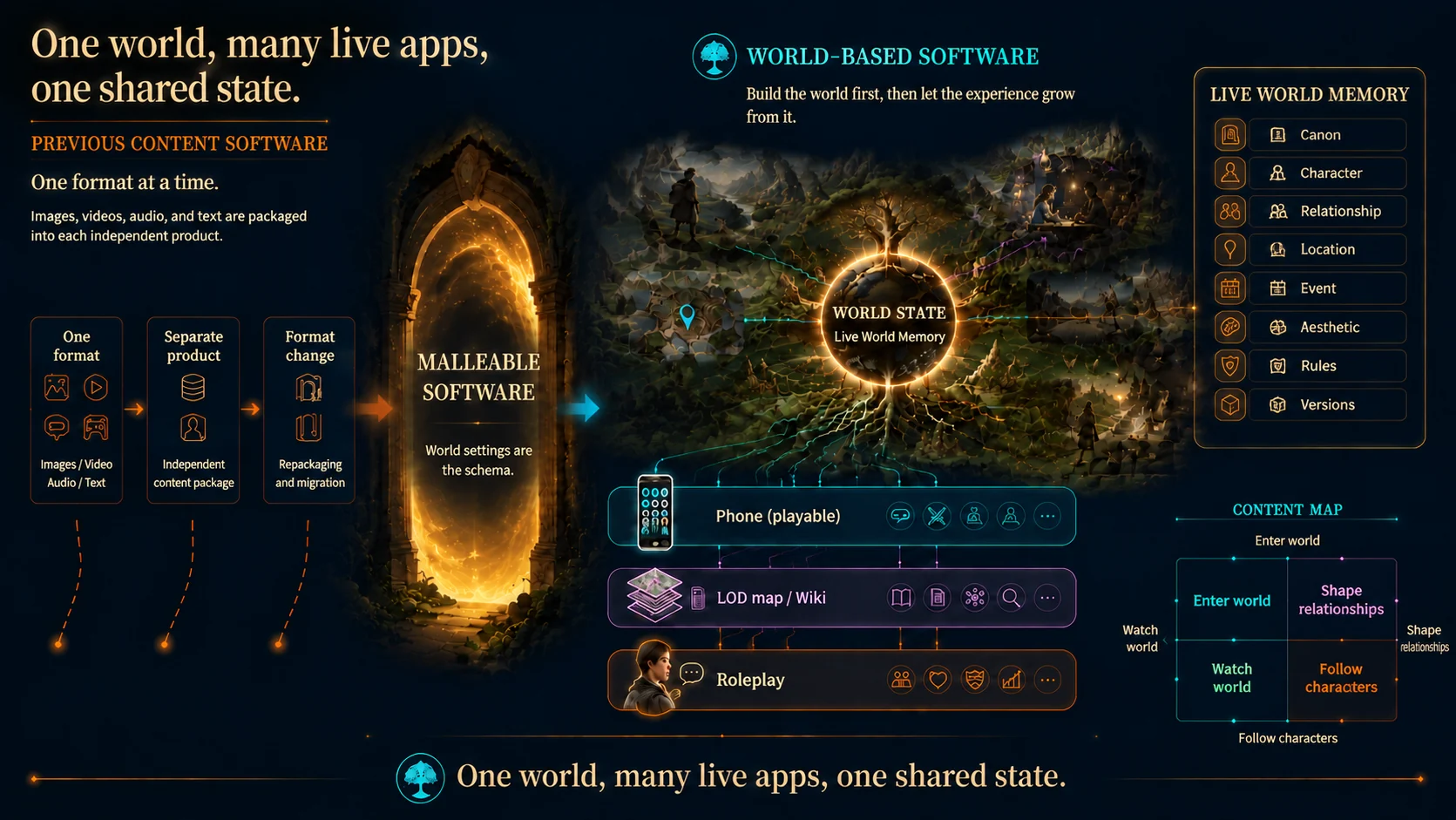
Our working model: build the world first, then let different experiences grow from the same state.
The interface may change. The world continues.
Three doors into the same world
These three surfaces each make a different part of the world tangible: relationships, space, and lived experience.
Door one: Small Phone
A phone-like surface makes a world feel personal and immediate. Characters can message you, shared history can appear in conversation, and other parts of the world can be arranged as familiar apps.
The important observation is not the phone skin itself. It is the expectation that chat, maps, worldbooks, homes, and other functions belong to the same underlying life.
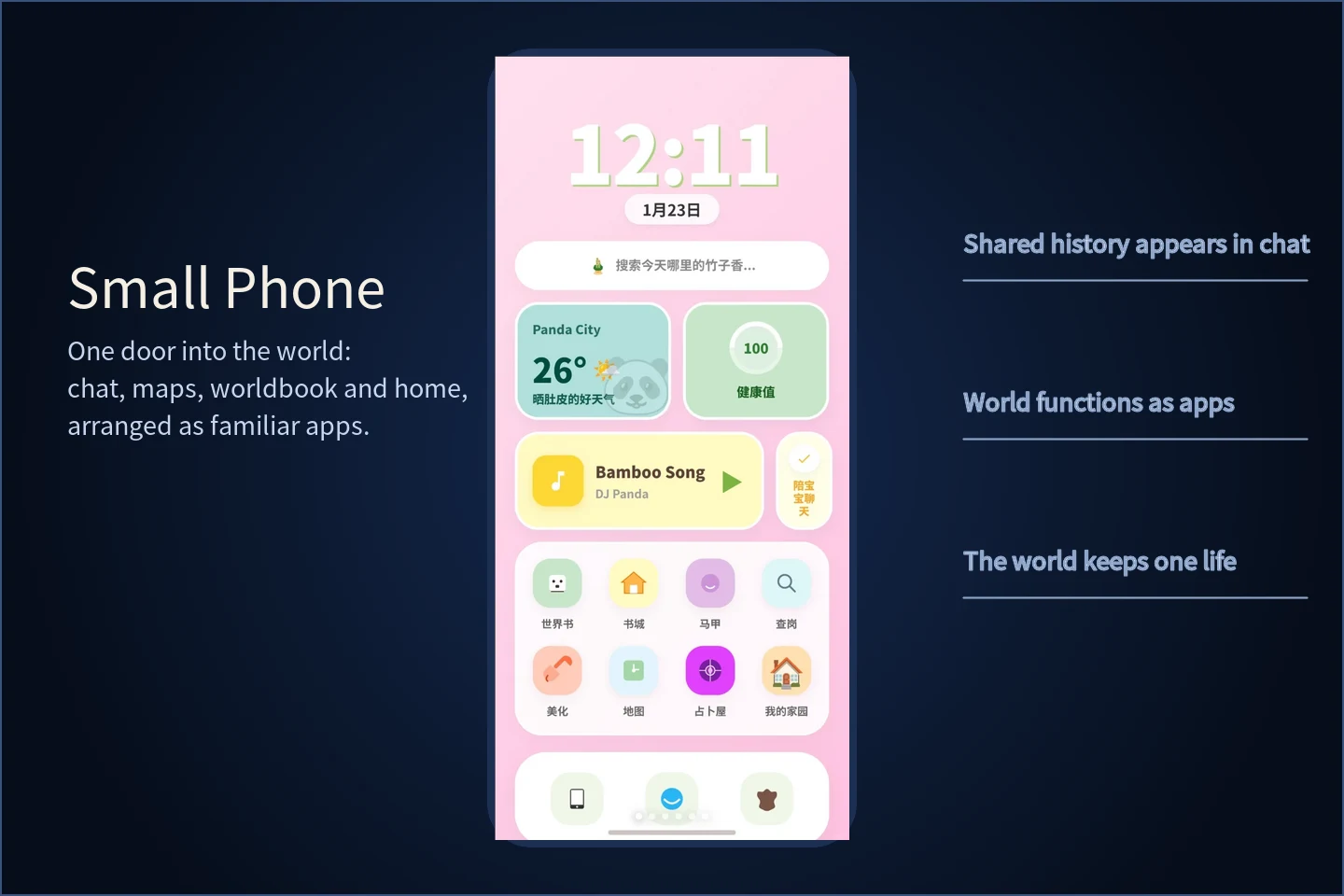
Creator-built prototype shared publicly in China; original interface shown in Chinese. The screenshot is used here as product evidence, not as a prescribed design.
Door two: the Map / Wiki
A map turns lore into navigable space. A location can carry its history, the characters connected to it, what has happened there, and what remains possible.
The map is not only a directory. It can become a visible record of how the world has changed.
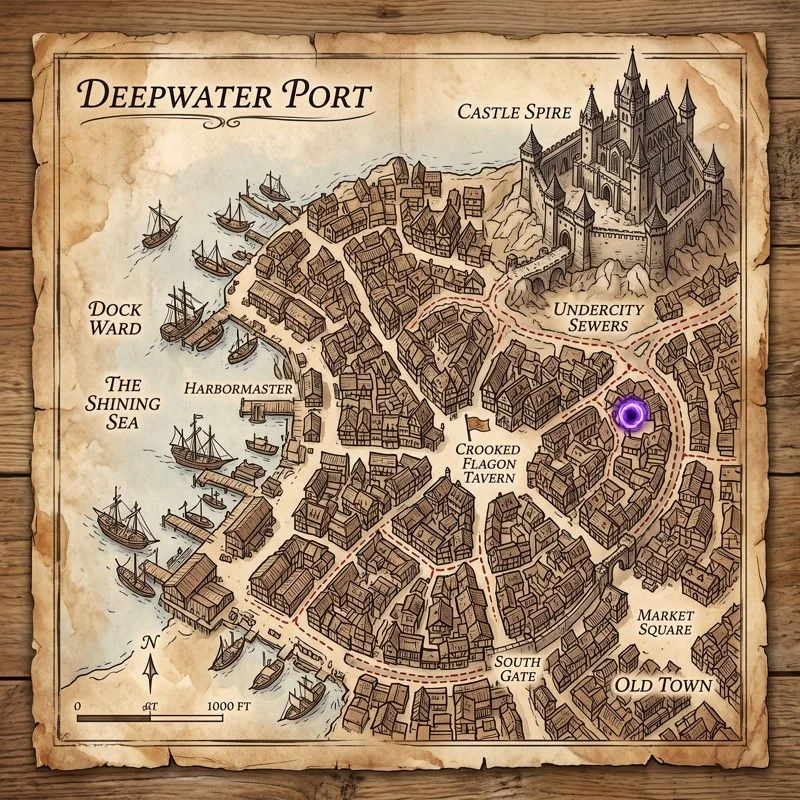
Deepwater Port as a navigable space — districts, routes, and the marked portal.
Door three: Roleplay
Roleplay lets someone enter the world at a specific moment. Characters, places, relationships, and unresolved events become an immediate encounter rather than background information.

An encounter in the Deepwater sewers — roleplay as a door into the same world.
If the world carries the result forward, the session is no longer a disposable branch. It becomes part of what the next experience can begin from.
What changes when memory is shared
The point is not that every action must permanently rewrite the world. The point is that the experiences are capable of sharing continuity.
Your action | What another surface could carry forward |
|---|---|
Comfort a character in Small Phone | The next roleplay can begin from a warmer relationship, rather than resetting to strangers. |
Discover a secret during roleplay | The map or wiki can reveal the place as explored, while later conversations can refer to what was found. |
Add or reveal a location on the map | Characters can mention it, and a future playable scene can begin there. |
These are not three separate products. They are three doors into the same house. Move something inside the house, and the change can be encountered from another door.
What this structure could make possible
Shared memory does not automatically solve reasoning, simulation, or storytelling. It does, however, create the conditions for three important forms of continuity.
Return without resetting
A later session can begin from what the world has already become, rather than reconstructing context from scratch.
Different forms agree
Chat, maps, stories, and playable scenes can reflect the same underlying changes instead of drifting into separate versions.
The world can continue
Within explicit rules and user control, characters and agents can act from existing state and create the conditions for what happens next.
The open design questions
A living world needs more than memory. It needs boundaries for what becomes part of the world, whose version is shared, and how much change can happen without the user.
What should persist?
Not every line of dialogue should become canon. Which interactions update the world, and which remain temporary?
Personal or shared?
When two people change the same world differently, do their experiences branch, merge, or enter a governed shared state?
How alive is too alive?
If characters act while you are away, does the world feel more alive — or does it feel as if control has been taken from you?
From content to a place you can return to
Malleability turns a world from something you consume into something you can inhabit. Live World Memory lets that place carry forward how it became what it is.
The interfaces will keep changing. The more durable question is whether the world beneath them can remember, remain coherent, and continue.
Live World Memory is the product face of what our five-layer essay calls the missing middle. Read the framework in Why AI Interactive Entertainment Needs a Five-Layer Structure.
- Build a world of your own: neta.art
- Explore worlds made by others: neta.art/explore
- See what creators are already building: 10 real use cases