Random Game Generator — Roll a Game Idea You Can Actually Play
Make your own random game generator
Roll a random game idea — genre, setting and twist — then play it in a 3D world right in your browser. Free game idea generator with no signup and no download.
A random game generator is only useful if what it generates is playable. This one rolls three values — a genre, a setting, and a twist — and then hands the same sentence to a 3D world builder that runs in the browser tab you already have open. No signup, no download, no engine install.
The roll is the small half. The larger half is that the sentence describing the roll resolves into a Three.js scene you can walk around in: ground geometry, sky, a lighting rig, collision, a player controller. You get a constraint and a place to put it.
Roll a Game Idea (Live Tool)
The roll button is the first interactive element on the page because it is the only thing that matters on a first visit. One press returns three values: a genre, a setting, and a twist. A typical result reads like 'stealth / lighthouse during a storm / gravity reverses every thirty seconds'. That is the entire output. It is one sentence.
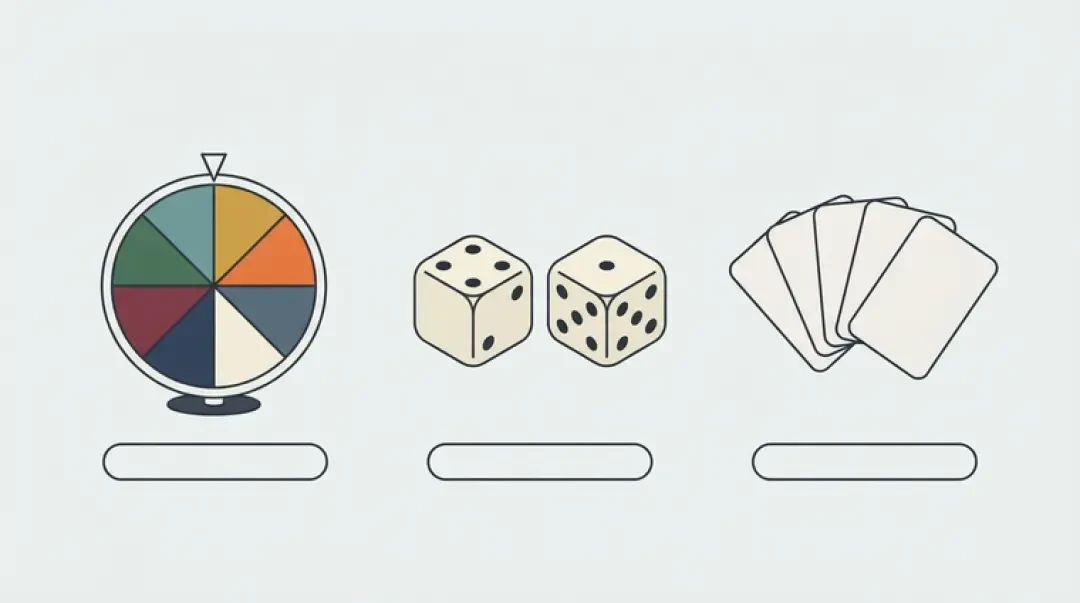
A roll is three independent draws from three closed lists. The genre axis decides what the player does: stealth, farming, tower defense, racing, survival, puzzle, management, platformer. The setting axis decides where it happens: a lighthouse, a drowned city, an orbital station, an overgrown mall. The twist axis decides the one rule that makes the combination specific rather than generic: light sources attract enemies, crops grow only in darkness, the floor is the only safe surface.
What a roll is not: a design document. There is no win condition, no economy, no level count, no scope estimate, no art direction beyond the nouns already in the sentence. If you want those, they come from you or from the next step, where the sentence becomes a world. Keeping the output small is deliberate. A generator that returns a full design produces something you argue with. A generator that returns three constraints produces something you push against.
Why three axes instead of one
A single axis is not a constraint. 'Make a stealth game' leaves the space nearly as open as 'make a game', because every default assumption still applies: a guard, a corridor, a shadow. Three axes intersect into something narrow enough to act on. The genre tells you the verb, the setting tells you the nouns, and the twist tells you the exception to the genre's normal rules. The idea lives in the intersection, not in any one axis.
- GenreThe verb. Stealth, farming, racing, survival, management, puzzle. Narrower than a mood, wider than a mechanic.
- SettingThe nouns. These are the words that become objects in the scene: lighthouse, station, mall, reef.
- TwistOne rule that contradicts the genre's default. It is the axis that turns a familiar loop into a specific one.
- Single-axis rerollRedraw one axis and keep the other two. Useful when you like the setting and dislike the genre.
Why a Rolled Idea Beats a Blank Page
The problem with a blank page is not a shortage of ideas. It is that you have too many equally valid ones and no reason to choose any of them, so the first hour goes into comparing instead of building. A roll removes the comparison. You do not get a better idea than the one you would have reached eventually. You get one sooner and cheaper.
A constraint turns 'anything' into 'this thing'. 'Make a game this weekend' is a sentence you can postpone indefinitely. 'Make a stealth game in a lighthouse where gravity reverses' already contains a first task: you need a lighthouse, you need a light source, and you need something that hides from it. That first task is the whole point. Starting is the bottleneck; inventing usually is not.
The claim here is modest. A roll does not make you more creative and it does not guarantee a good idea. It converts an open decision into a closed one in about a second. Some rolls you will dislike on sight, and those are still useful — disliking a specific three-axis result tells you which axis you object to, so you can keep the setting, reroll the genre, and move on.
From Idea to a Playable 3D World
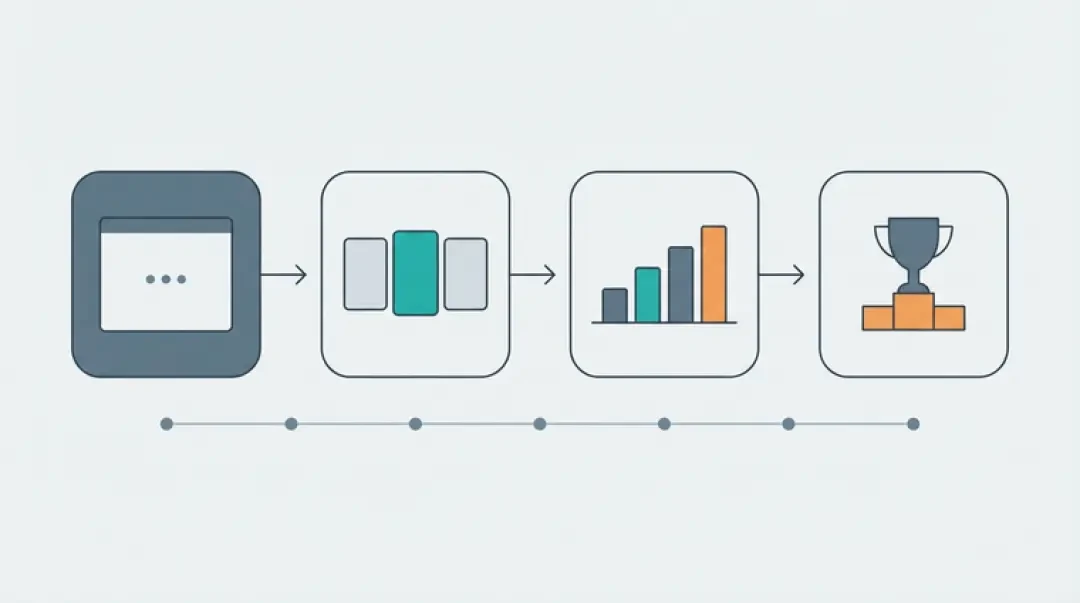
The same sentence the generator prints is a usable world prompt. The pipeline is one sentence in, one world out. You paste the roll into the 3D game builder and it returns a scene: terrain geometry with a material, a sky, a directional light with a shadow map, a player capsule with a collider, and a spawn point. The scene runs in the browser on Three.js. Nothing is installed and nothing is compiled.
What actually breaks at this step is scale and specificity. 'Make it atmospheric' returns the default fog density and the default light rig, because there is nothing in the sentence to resolve. 'Fog ends twenty meters out, one tower eighteen meters tall, three light sources' returns something you can navigate. Named props land correctly where the terrain is flat; ask for a lighthouse on a cliff and a sloped base floats, which you fix by asking for a flattened footprint under it.
The Cyclops' Island and Mini World both follow this shape: a sentence, then a scene, then edits. Cyclops' Island is a survival loop on a fixed island footprint, with a bounded shoreline. Mini World is smaller and denser, built for a shorter session. Neither started as a design document, and neither needed a build pipeline to become playable.
01
Roll the three axes, or type your own sentence if you already know what you want.
02
Paste the sentence into the builder's prompt field. Keep the nouns from the setting axis in the text — they become objects.
03
The builder emits a scene graph: ground, sky, lighting rig, player controller, and placement for named props.
04
Walk it with the keyboard and look with the mouse or trackpad. This is the step that tells you whether the idea has legs.
05
Change one thing at a time in plain language — fog distance, tower height, number of enemies — and re-check.
Random Game Name & Character Generator
Names roll separately from the idea because a good name is a separate problem with a separate failure mode. Two concrete nouns beat one abstract noun almost every time. 'The Lighthouse Lantern' tells you the setting, the key object, and half the lighting plan. 'Solitude' tells you nothing you can draw. Concrete nouns are also searchable and speakable, which matters more than elegance when you have one line to describe your project to someone.
A character roll returns three fields: a role, a limitation, and one prop. Role is what the character does inside the loop — keeper, diver, scavenger. Limitation constrains how they do it — cannot swim, carries no light, moves only while unseen. The prop is the single object the art has to model. Three fields is enough to make the character behave differently from the player's default, which is the only reason to add one at all.
Characters attach to the world rather than floating free. In the builder a character is a spawn point, a collider, a camera follow or an AI state machine, and a mesh. If that mesh is a sprite, Agent Sprite Forge generates a sprite sheet mapped to the same animation states the controller already uses — idle, walk, attack. A character that exists only as a paragraph of backstory does nothing in the scene.
Naming patterns that survive a title bar
The pattern that holds up is [concrete object] of the [concrete place], or a two-word compound of the same. It stays readable at small sizes, it does not collide with existing marks as often as a single invented word does, and it gives whoever draws the key art something to draw. Abstract one-word names fail the same way every time: nobody remembers them and nobody can picture them.
Great for Game Jams and Idea Block
For a jam the roll is the brief. Roll once at kickoff with the whole team watching and write the three axes somewhere visible. Do not reroll because somebody dislikes the setting; reroll only when the genre is technically impossible in the time you have. A physics-heavy genre in a 24-hour jam with one programmer is a real blocker. A setting that someone finds boring is not.
Set the box before you roll: fixed hours, a scope ceiling, and a rule that the first idea nobody hates is the idea. A roll costs nothing, which means teams will reroll indefinitely if you let them. Cap it at two rolls and put the cap in writing.
01
Roll once with the team present.
02
Write the genre, setting, and twist where everyone can see them for the whole jam.
03
Set the time box and the scope ceiling before anyone opens the builder.
04
Accept the first roll that nobody actively hates. Dislike is not a veto.
05
Cut anything that does not serve the genre's core verb.
| Jam shape | How to use a roll | What to cut |
|---|---|---|
| 48-hour jam | One roll at kickoff, no rerolls | Multiplayer, save systems, more than one level |
| One-week jam | Roll once, roll a second twist midweek if the loop feels thin | Custom art pipeline, voice, cutscenes |
| Solo weekend | Roll, then reduce the genre to its single verb | Pathfinding enemies, inventory, dialogue trees |
| Team of four | Roll, then give each discipline one axis as a constraint | Anything not visible in the first thirty seconds |
| Three-hour micro jam | Roll setting and twist only; pick a genre you already know | New mechanics, new assets, tutorials |
From a Rolled Idea to a Game You Can Share
A world in the builder is a page with a link. Publishing produces no build artifact, no packaged binary, and no store review queue. You save the world and the world has an address. Anyone with the link opens it in a browser and is standing in the scene.
What that changes in practice is feedback latency. You can send the link while the world is half-finished and get a reaction the same day. The failure modes are different from a build pipeline: the world depends on the runtime behind the link, so a broken terrain generation step breaks it for everyone at once, immediately. Keep a copy before large edits.
What publishing does not do: it does not monetize, it does not put you on a storefront, and it does not give you a dedicated server. It gives you a link and a scene. For jam entries, prototypes, and teaching, that is the entire requirement.
Walk into the world it belongs to
A sprite is a character with nowhere to stand. The last step is the one nobody else offers: take the sheet you just built and put it in a world someone can walk around in — a small island, a planet, a rainy street corner. Every world on this site was made from one written description and published as a page you can play.
FAQ
Is it free? +
Yes. The roll tool and the world builder both run in the browser with no payment step, no trial timer, and no gate on the roll itself.
Is it truly random? +
Each axis is an independent draw from a fixed list. There is no weighting by popularity and no model call behind the button, so the same combination can come up twice in one session.
Can I roll a whole game? +
No. A roll returns a genre, a setting, and a twist — three constraints, roughly one sentence. A playable game also needs a win condition, a loop, and a scope decision, and those come from you or from the world-building step.
Can I keep a roll? +
Yes. Copy the sentence. Single-axis rerolling keeps the other two values, so you can hold onto a setting you like and exchange the genre underneath it.
Do I need an account? +
Not to roll. You need one to save a world and get a link you can share, because a link has to point at something that is stored.
Can I publish what I roll? +
Yes. A roll carries no restrictions from us — it is a few words drawn from a list. What you build from it is yours.
How many genres are in the pool? +
The pool is a hand-written, finite list rather than a generated stream, and it stays deliberately small. That means repeats happen in a normal session, which is useful: a constraint you recognize is easier to push against than one you have never seen.
Is it a replacement for a game designer? +
No. It replaces the blank page, not the designer. It has no view on which of the three axes matters most for your team, what your budget is, or whether a given twist is implementable in the time you have. Those calls stay with you.
Back to the 3D Game Builder
All 31 finished 3D worlds, games and scenes live on one page — every one of them playable.