Bridgerton Family Tree — Bridgerton, Featherington, Sharma and Hastings Networks
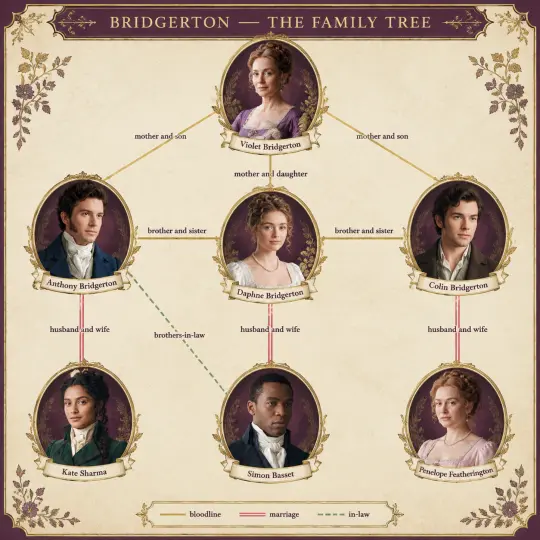
The Bridgerton family tree as four interactive networks: 24 characters, 8 locations, 4 events and 3 factions, with every parent, spouse, sibling, adopted, mentor and loyalty edge held as explicit data.
The Bridgerton family tree, without the guesswork
Bridgerton is a show about marriage, but its family tree is where the marriage market becomes personal. Violet Bridgerton has eight children and a name to protect. Portia Featherington has three daughters and a fortune that is already gone. Mary Sharma has two daughters, a borrowed title and a mother who cut her off. Simon Basset has a dukedom he took only to deny his father a legacy. Four households, one season, and a set of relationships that change meaning with every ball.
This archive treats the Bridgerton family tree as data, not decoration. Every parent, spouse, sibling, adopted, mentor and loyalty connection is a named pair in a file. The interactive networks draw those pairs; an image model is never asked to invent a line. The result is a tree you can check, filter and argue with — which is the only kind of Bridgerton family tree that makes sense.

The families
The Bridgerton story is not one tree. It is four households negotiating the same London season. The Bridgertons ask who inherits and who is allowed to marry for love. The Featheringtons ask what survival costs when the title is real and the money is not. The Sharmas ask what a sister owes her family and what she owes herself. The Hastings line asks whether a title can be refused without refusing the person who loves you. Each network has its own cast, its own centre and its own way of failing.
The Bridgerton network
Violet and Edmund raised eight children on a house that runs on love, noise and a very precise sense of duty. Anthony inherits the title and the fear. Benedict inherits the studio. Colin inherits the road. Daphne inherits the season. Eloise inherits the argument. Francesca inherits the piano. Gregory and Hyacinth inherit the run of the house. Kate Sharma and Penelope Featherington marry in and change the arithmetic. This network has twelve characters and thirty-one explicit edges, including the parent lines from Violet and Edmund, the sibling lines that carry the family's longest grudge, and the marriages that bring the Sharmas and Featheringtons inside the Bridgerton house.

The Bridgerton network
Open the network to read every connection.
The Featherington network
Portia Featherington has three daughters, a dead husband, a title with no money behind it and a talent for turning other people's scandals into her family's next move. Prudence performs. Philippa escapes. Penelope watches, writes and becomes the most powerful person in the room. Marina Thompson is the pregnant cousin used as a placement; Jack Featherington is the American cousin who sells the family a ruby mine that does not exist. This network has nine characters and seventeen explicit edges, including the parent lines from Portia and Archibald, the adoption of Marina into the household, and the marriage that turns Penelope into a Bridgerton.

The Featherington network
Open the network to read every connection.
The Sharma network
Mary Sharma returns to London with two daughters, a borrowed title and a mother who cut her off for marrying beneath her. Kate arrives to secure Edwina's future and ends up arguing with the one man who can match her. Edwina is named the diamond and discovers that being perfect is not the same as being understood. Lady Danbury sponsors the family, Queen Charlotte anoints the diamond, and Violet Bridgerton becomes the mother-in-law Kate never expected. This network has eight characters and fifteen explicit edges, including the mother-daughter lines, the Sheffield grandmother line and the marriage that ends the duel.

The Sharma network
Open the network to read every connection.
The Hastings network
Simon Basset inherits a dukedom he took only to deny his father a legacy. Daphne Bridgerton needs a suitor who will not confuse her. Their fake courtship becomes a marriage, and the Hastings line becomes the place where the Bridgertons, the Sharmas, Lady Danbury and the Queen's court meet. This network has nine characters and twenty-one explicit edges, including Simon's guardianship under Lady Danbury, the Queen's public approval, and the brothers-in-law who once stood at dawn with pistols.

The Hastings network
Open the network to read every connection.
Seven profile cards
The archive includes seven archival profile cards, each made with the character-profile-card skill: Violet Bridgerton, Anthony Bridgerton, Kate Sharma, Penelope Featherington, Colin Bridgerton, Daphne Bridgerton and Simon Basset. Each card is a full dossier, not a portrait: age, identity, likes, dislikes, personality, a COMBAT radar chart, a TACTICS radar chart and a five-line character introduction. The cards sit inside their family sections on the hub, so you meet Violet with the Bridgertons, Penelope with the Featheringtons, Kate with the Sharmas and Simon with the Hastings line.


Five design sheets
Five characters also have full design sheets made with the character-design-sheet skill: Anthony, Kate, Penelope, Daphne and Simon. Each sheet shows a front, side and back view at the same scale, four expression heads, detail callouts for gloves, boots, jewellery and signature item, and a small colour palette. The sheets are visual references, not posters: they exist so the same face and costume can be reused across the networks and the poster.


Why a network instead of a poster
A poster is a picture of a family tree. A network is the family tree itself. In the four interactive networks, every edge is a source-target pair with a relation type, so a line cannot drift to the wrong person. You can switch views: the whole family, the blood and marriage line, the London season, or the marriage that ends the argument. You can click a face and read the relations around it. You can use it on a phone. None of that is possible when an image model is asked to draw a family tree from prose.
The poster still matters, but it has a different job. It is the one-glance summary: seven faces, nine correct edges, a legend that separates bloodline, marriage and in-law. It is generated from the same cast and the same pairs, so it cannot contradict the networks. That division of labour is the whole point: the networks hold the argument, the poster holds the image.
The data is also the fact-check. If a character is added to a network, the edge list changes first. If a marriage is wrong, it is wrong in the data before it is wrong in the picture. That is how the archive keeps show canon and book canon separate instead of blending them into a handsome mistake.
Finally, a network is honest about uncertainty. The Bridgerton novels and the Netflix series do not agree on every ending. The archive marks show-only inventions, book-only endings and shared facts, and the networks only draw the relations that are actually in the data.
Frequently asked questions
Is this canon?
The relations follow the television series first and Julia Quinn's novels second. Every atom marks whether a fact is show-only, book-only or shared. The archive does not invent a relation to fill a gap.
Why are there four networks?
A single graph with every character becomes unreadable. Four networks keep each household legible and let you start from the question you actually have: inheritance, survival, sisterhood or the Hastings line.
Is Penelope really Lady Whistledown?
Yes. Penelope Featherington writes Lady Whistledown's Sheet. The show reveals the secret to Colin in season three; the books use a different sequence of reveals. Both are marked in the archive.
Are Kate and Edwina sisters?
Yes. Kate is the elder daughter and Edwina the younger. Their mother is Mary Sharma; their grandmother is Lady Mary Sheffield. The show makes Kate Edwina's protector; the books give Edwina a quieter ending with Mr. Bagwell (book-only).
Is Simon's father in the tree?
The late Duke of Hastings is part of Simon's backstory, but the archive keeps the Hastings network to living relationships and the guardianship under Lady Danbury. His cruelty is described in Simon's canon note, not drawn as a node.
Can I use this on a phone?
Yes. The networks are built to be dragged, zoomed and tapped. The hub and the archive page reflow to a single column, and the images are served as compressed WebP files.
Open the archive
Start with the hub, then open the Bridgerton network and click a face. If you want the marriage market, open the Featheringtons. If you want the sister argument, open the Sharmas. If you want the duke, open the Hastings line. The poster is there when you need the whole family in one glance.
Open the Bridgerton hub
Every layer of this archive was built with four named skills: relationship-network for the four interactive graphs, character-relationship-poster for the family poster, character-profile-card for the seven dossiers, and character-design-sheet for the five turnaround sheets. The data, the drawings and the pages are separate on purpose, so each one can be checked against the others.