Solo RPG on Reddit: What the Threads Get Right

The four questions every solo RPG thread asks, the advice that actually holds up, and how to test an oracle or an AI scene in twenty minutes.


Why solo RPG questions all sound the same
Ask about solo roleplaying in a forum and you will get four kinds of answer, in roughly the same order every time: a system recommendation, an oracle recommendation, a warning that it is really creative writing, and someone describing a campaign they have run for six years. That repetition is useful. It means the hobby has converged on a small set of real problems, and the arguments are about tools rather than about what the activity is.
This page is a reading guide rather than a thread. It summarises what the recurring conversations actually agree on, where they disagree for good reasons, and how to test any recommendation — a system, an oracle, or an AI scene — in twenty minutes before you spend an evening on it.
| Where | Solo-RPG forums and communities such as r/Solo_Roleplaying |
| The argument | System vs oracle vs journal vs AI |
| Consensus | Record what happens; ask before you narrate |
| Test | One 20-minute scene, one written line |
Test the advice on one scene
Take the twenty-minute test with a real scene: one character, one question, one answer you did not choose. The roleplay skill plays the world’s side while you keep the dice.
The four threads, and what each one is really about
Every recurring question in the solo RPG corner of Reddit is a version of one of these. Knowing which one you are asking saves you a week of reading.
- “How do I start?” — Not a system question. It is a scope question — people fail because they begin with a campaign instead of a scene.
- “Do I need an oracle?” — A question about who owns the surprises. An oracle is the cheapest way to stop agreeing with yourself.
- “Is this just writing?” — The honest answer is that it shares a desk with writing and differs in one place: you do not get to decide what the world does.
- “Can an AI be the GM?” — The newest version of the oracle argument. It is good at voice and continuity, bad at saying no unless you make it.
The advice that holds up, and the advice that does not
The best-regarded advice is boring and structural: start with one scene, keep a log, ask the oracle before you narrate, and stop at a chapter break. The advice that ages badly is tool-shaped — a specific app, a specific deck, a specific model — because tools change and the handoff does not. When a thread recommends a purchase, read the two comments underneath it; they are usually the ones describing what the tool does not do.


Six scenes to test a tool against
Each of these is a single-player-shaped scene: one character, one room, a world that answers back. Use one as your twenty-minute test instead of building a campaign first.



How to read a recommendation thread
Separate the claim from the campaign. “This oracle is incredible” usually means “this oracle surprised me twice in a session I was already enjoying”; the useful part is the two surprises. Look for the comment that says what a tool cannot do — that is the one written by someone who has used it for a year. And ignore any recommendation that begins with a full campaign structure: the best starting advice is almost always one scene long.
Where an AI scene actually helps
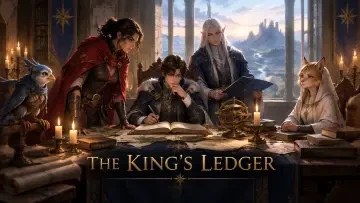
It helps with the part solo play finds hardest: a cast that answers in character without you writing both sides. Casefile: You is a good test case — a mystery needs a world that withholds information, and a scene that only agrees with you cannot withhold anything. The King’s Ledger shows the other half: four advisors with different interests, which is what a good oracle table feels like when it is talking.
The twenty-minute test
One scene, one question
Write a situation that can resolve in one scene and one question your character needs answered. No campaign, no character sheet longer than three lines.
Ask before you narrate
Put the question to the tool — oracle, table, or scene — and accept the first answer. If you re-roll, you are writing, not playing.
Write one line and stop
One sentence about what changed. If you want to come back tomorrow, the tool passed. If you do not, you saved an evening.
Six characters to test with








Stop reading threads, play one scene
The fastest way to settle the argument is a single scene you finish. Pick one, run the test, and keep the log line.
Made with the roleplay skill
roleplay plays the world’s side of the table: NPC voices, consequences, and continuity across scenes. trading-card gives a character a stat card so the tactical layer stays visible, and the solo tabletop guide linked below covers the systems and oracles that do the same job without a screen.
FAQ
Is there a good subreddit for solo RPGs?
Yes — r/Solo_Roleplaying is the dedicated one, and the wider r/rpg community answers solo questions regularly. Read the pinned beginner threads before posting; most first questions are already answered there.
What do people usually recommend for a first solo game?
Ironsworn for structured fantasy, Thousand Year Old Vampire for journaling, and a generic oracle deck if they already own a game. The recommendation depends on whether the asker wants tactics or writing.
Is using an AI the same as using an oracle?
Related but not identical. An oracle answers a constrained question; an AI scene answers in a voice and remembers it. The risk with the second is agreement — you have to keep the authority to say no.
Do I need to journal?
You need a record, not a diary. One line per scene is enough, and it is the difference between a campaign you can resume and an evening you half-remember.
Why do people say solo play is really writing?
Because the output looks like prose. The distinction is control: in solo play the world can refuse your plan, and a session with no refusal usually means the oracle was decorative.
How do I stop a solo session from stalling?
Ask a smaller question. Stalls are almost always scope problems — the scene wanted an answer that a single roll could not give. Narrow it to one decision and play that.
Keep reading
Platform: Neta Studio · Type: Community guide · Hub: neta.art/app/roleplay · Works: The Court Card · Casefile: You · Method · The King’s Ledger · Patty’s Oath · Starfall Return
