
From One Sentence to a Playable Game: What a Generator Decides and What You Still Do
Type a sentence. Get a game. That is the promise, and at Neta Studio it is roughly true: one sentence to a playable game runs end to end in a browser tab, no install, no project setup. But "playable" is doing a lot of work in that sentence. The generator makes five decisions before you ever see a frame, and it makes them from a small library, not from first principles. If you understand which decisions those are, you can write a brief that survives contact with the pipeline. If you do not, you will blame the tool for something that was wrong in your prompt.
This post walks the actual pipeline. What gets parsed, what gets picked, what gets generated from scratch, and what remains yours. Then the two failure modes that generate the most bad output, and why neither is a bug.
What "one sentence to a playable game" actually compiles
A generator is not a designer. It is a compiler with a narrow target: a structured game description that the runtime can execute. The input is a natural-language line. The output is something closer to a config file than a design document.
The pipeline runs in four stages, and each one throws away information.
Stage 1 — Parse. The sentence is tokenized and mapped onto slots: subject/theme, implied action, spatial nouns, tone words, quantity words, and any explicit constraints ("no shooting", "top-down"). Most briefs are underspecified here, and the parser fills gaps with defaults rather than asking. This is where a missing verb becomes fatal, because there is nothing to map onto the action slot.
Stage 2 — Classify. The slot set is matched against the rule template library. This is a lookup, not a synthesis. The library has a fixed number of templates — board-and-capture, collection-with-obstacles, lane-defense, runner, arena-survival, puzzle-grid, and a handful more. Your brief picks one, or gets the nearest match with a confidence score. Close matches produce games that feel almost right.
Stage 3 — Instantiate. The template is expanded into concrete values: board dimensions, entity count, movement speed, spawn cadence, collider sizes, camera rig, palette, material settings, light rig, particle budget, UI layout. These are drawn from ranges keyed to the template and modulated by tone words. "Cozy" pulls toward warmer light temperatures and slower cadence. "Frantic" pulls the other way. The generator does not invent these ranges; they ship with the template.
Stage 4 — Emit. The instantiated description becomes a Three.js scene graph, an input map, a scoring model, and a page. The scene is real geometry, real materials, real lights. Nothing here is a video or a mockup.
The whole thing runs client-side enough that you get a first frame quickly, and a loadable page when it is done. You can then edit any of the emitted values.
The first frame is a draft, not a verdict. Regenerate three times from the same prompt before you conclude the generator cannot do something. Template selection is nearest-match, and a one-word change in the brief frequently moves you to a different template entirely.
The five decisions the generator makes for you
These are the decisions that are effectively out of your hands at generation time, because they are what the generator actually does. You can override any of them afterward in the editor. Knowing which ones moved without asking is the difference between debugging your game and debugging your brief.
Board shape
The template constrains the topology. A capture template wants a tiled plane with a bounded perimeter. A runner template wants a corridor with forward culling. A survival arena wants an open disc or rectangle with a radial spawn ring. The generator picks the shape that fits the template, then scales it. You can resize the plane and shift the bounds, but you cannot turn a corridor into a hub-and-spoke map without swapping templates.
This matters more than people expect. Board shape determines how much of the world the player sees at once, which determines how much information they have to hold in their head, which determines how hard the game feels. A board that is 20 percent too large reads as "empty" even if every other number is identical.
Rule set, from a small library
The generator picks rules from a fixed template set. It does not compose new rule interactions. If your brief implies a mechanic that is not in the library, you get the nearest template, and the mismatch shows up as a game that works but does not feel like what you described.
Concretely: a brief about "defending a garden from insects" maps onto lane-defense or arena-survival depending on phrasing. Those are different games. One has chokepoints and a fixed approach vector. The other has a spawn ring and no spatial strategy beyond kiting. The generator will pick one and commit.
Visual register
Palette, material roughness and metalness, light rig, fog density, camera FOV, and post-processing (if any) come in a bundle keyed to the tone words and the template. The generator does not design a look. It selects one and applies it consistently.
The useful consequence is internal consistency: you will not get a toon-shaded character in a physically-based environment. The limiting consequence is that your game will look like one of the registers, not like a thing nobody has seen.
Entity and effect budget
The generator sets counts: how many enemies, how many collectibles, how many particles per burst, how many draw calls the scene is allowed. These are tuned for a browser tab on mid-range hardware, not for a workstation. If you raise counts in the editor, you are spending the budget the generator was protecting.
Scoring model
How points accrue — per pickup, per second survived, per enemy cleared, per distance, with or without a combo multiplier — is set by the template. This is the decision people notice last and change first, usually after playtesting reveals that the score does not reward the thing the game is actually about.
Decision | Who picks at generation | Your realistic override cost |
|---|---|---|
Board shape | Template topology, scaled | Resize and re-bound: minutes. Change topology: swap template |
Rule set | Nearest template in library | Pick a different template, re-instantiate |
Visual register | Tone words + template bundle | Swap register or hand-tune materials and lights |
Entity / effect budget | Template defaults, browser-tuned | Raise counts, watch frame time |
Scoring model | Template default | Rewrite scoring events and weights |
The four things that are still yours
The generator can hand you a running scene with rules and a score. It cannot decide what the game is about. Four decisions stay with you, and skipping any one of them produces a build that is technically complete and practically unplayable.
1. The win condition
"Survive" is not a win condition. "Survive 90 seconds" is. "Collect the relics" is not. "Collect all six relics, at which point the exit opens" is.
The generator will default to a template-appropriate condition, and that default is almost always a placeholder. It does not know whether your game is about endurance, completion, or optimization. Those imply different fail states, different HUD elements, and different pacing. Write the win condition as a sentence with a number in it.
2. The difficulty curve
Generators produce a flat difficulty profile with a single scalar. Real games ramp. You decide where the ramp starts, how steep it is, and whether it has a plateau before the final push.
In practice this means editing spawn cadence, movement speed, and resource availability over time rather than as constants. A useful invariant: the first 20 seconds should be winnable by someone who has never seen the game, and the last 20 seconds should be winnable only by someone who has played it once. That gap is the curve, and it is authored, not generated.
3. The feedback the player sees immediately
What happens in the first 250 milliseconds after an input is the entire feel of the game. Does the character squash? Does the pickup pop with a scale tween? Does the score counter tick with a slight overshoot? Does the hit flash the screen edge?
The generator gives you a consistent baseline, usually conservative. It will not know that your game needs a heavier hitstop on the third combo hit. That is a judgment about what the game is about, and it is yours. Tune it by playing, not by reading settings.
4. What the game is called when you share it
The title, the description on the page, and the one-line pitch are the whole of your game's first impression. The generator will produce a title derived from your prompt, and derived titles are consistently worse than authored ones because they are descriptive rather than evocative. "Garden Defense Game" is a derived title. It tells the player the template, not the fantasy.
Playtest the win condition before you tune anything else. A build with a wrong win condition cannot be balanced — you will spend an hour adjusting spawn cadence to fix a problem that is actually "the game does not end."

What a generator will not do
Three things are outside the pipeline by construction, not by limitation of effort.
It will not invent a novel mechanic. The rule library is finite and shared. Anything the generator produces is a recombination of rules that already exist in it. If your game's value is a mechanic nobody has played, generation gets you to a prototype for the surrounding structure — camera, UI, scoring — and you implement the mechanic yourself. That is still a large time save, but it is not the part you were excited about.
It will not balance a competitive game. Balance requires a population of players and iteration against their behavior. Generation produces a starting point with plausible numbers. Two-player or leaderboard-competitive balance is a separate project that begins after generation, and it needs real match data.
It will not tell you your idea is bad. The generator is compliant. It will build the thing you asked for, including the parts that are not fun, and it will do so without complaint. There is no taste check in the pipeline. If your brief describes a mechanic that cannot produce interesting decisions, you will get a working game with no interesting decisions, and it will look fine.
Failure mode one: the prompt with no verb
This is the most common bad brief, and it produces the most confusing output.
"The inside of a lighthouse at night."
That is a setting. There is no action slot to fill, so the action defaults to the template's generic verb — usually "move and collect" — and you receive a beautifully lit lighthouse interior with pickups scattered in it that have nothing to do with lighthouses. The scene is correct. The game is arbitrary. People look at this and conclude the generator does not understand atmosphere. It understood the atmosphere fine. You did not give it a verb.
The fix is one word. "Climb the lighthouse stairs before the light goes out." Now the action slot is filled, the template selection has something to match on, and the scoring model has a reason to reward progress along a path.
A quick test before you submit: find the verb. If the verb is "be", "explore", or "experience", the game has no action and the generator will invent one you did not ask for. If the verb is "collect", "escape", "defend", "reach", "outrun", "stack", or "guide", you have something the pipeline can compile.
Prompts with no verb still generate. They just generate a scene with a game bolted on. This is the single most reported "the tool misunderstood me" case, and it is a prompt problem every time.

Failure mode two: theme without mechanic
The second failure is subtler because the prompt reads as complete.
"A cyberpunk city where it rains."
Theme, tone, setting. No mechanic. The generator picks a template — probably an open arena with collection, because that fits "explore-able city" — and you get a rain-soaked street with glowing signs and floating pickups. It looks like the reference. It does not play like anything.
The distinction is between what the world is and what the player does. "A cyberpunk city where it rains and you deliver packages against a timer while dodging traffic" is a mechanic. "A cyberpunk city where it rains and you hack cameras to open a path before the patrol returns" is a different mechanic and a different game, from the same theme.
Brief | Verb present | Mechanic specified | What you get |
|---|---|---|---|
"A lighthouse at night" | No | No | Lit scene, arbitrary pickup game |
"Climb the lighthouse before the light dies" | Yes | Implied, spatial | Path-progress game with a timer |
"A cyberpunk city in the rain" | No | No | Rainy arena, collection default |
"Deliver packages against a timer in a rainy city" | Yes | Yes | Runner or route-optimization game |
Notice that the two working rows are not longer. They are the same length with a verb and a pressure added. The generator does not need more words. It needs the right kind of words.
The publish step: a game is a page with a link
Once the build runs, publishing is one action. The game becomes a page. The page has a link. That link is the game — there is no launcher, no store, no build pipeline you manage.
Three practical consequences:
The page loads in a browser tab, so your performance ceiling is a browser tab. That is why the generator's entity and effect budgets are set where they are. If you raise them substantially, test on the low end of the hardware you expect, not on yours.
The link is the distribution unit. That means the title and the description on the page are not decoration. They are the first 100 milliseconds of the player's experience, and they are the only part that travels without the game.
A page can be revised. Publishing is not a release event. You can change the difficulty curve after sharing the link, and the next visitor gets the new build. There is no version to manage unless you want one.
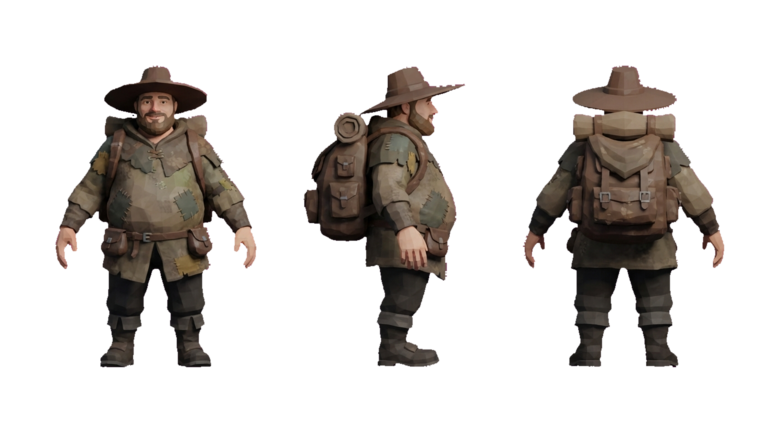
Four playable builds made this way
These exist now. Each started as a sentence.
Agent Sprite Forge — a character-driven build where sprite-like agents are the subject and the mechanic is assembly and direction. The interesting part is that the visual register was selected before the rule set was tuned, which meant the materials and light rig were fixed early and the difficulty edits happened inside that look.
The Cyclops' Island — an island setting that needed a verb. The first brief described the island; the working brief described what you do there. That change moved it off the default collection template and onto something with a spatial objective, which changed the board shape and the scoring model together.
Mini World — a small-scale, bounded build. Small boards are the easiest to get right because the information load per screen is low, which means the difficulty curve is mostly about cadence and less about navigation. It is a good first project for exactly that reason.
The 3D game builder — the tool itself, used as its own test case. The pipeline is exercised against real briefs continuously, and the templates in the library are the ones that survive that.
None of these were generated once. Each is a generated starting point plus authored win condition, authored curve, authored feedback, and an authored title. That is the honest split, and it is roughly the split you should expect on your own build.
Writing a brief that compiles
There is no trick to this. There is a checklist.
Include a verb in the imperative: what the player does, not what the world is. Add one number, so the generator has a scale to work against — a count, a duration, a distance. Name the pressure: a timer, a pursuing entity, a degrading resource, a limited move count. Leave the theme in, but do not lead with it. The theme modulates the visual register; the verb drives template selection, and template selection is the decision that determines whether you get a game or a scene.
Then play it once before you edit anything. The generated build tells you which template you actually landed on, and that is information you cannot get from reading your own prompt. From there, the four decisions are yours: win condition, curve, immediate feedback, title. The generator gave you a running page in the time it took to type a sentence. The rest is design, and it was always going to be.
Keep going
- the random game generator
- the AI 3D game maker
- making a 3D game with AI
- making a game with no coding
- Mini World
Build the world it walks in
A character, a tile or a model is a material with nowhere to stand. Every world on the 3D game builder was made from one written description and published as a page you can play — including Mini World and The Cyclops' Island.