
How to Make an RPG Without Combat (And Why It Often Plays Better)
Most beginners building their first RPG start with damage. Hit points, an attack animation, a cooldown, a chase state, a death state. That is the most expensive possible first choice, and it is usually made before anyone has checked whether the world is worth walking through. Building an rpg without combat inverts the order. You build the room, the character, the obstacle, and the ending first, and you discover early whether those four things can hold a player's attention without a damage number covering for them.
This is not a purity argument. Combat is fine. Combat is also a solved problem that you will not solve better than the games you grew up on. What follows is a build order, the systems that replace the combat loop, and the three ways combat-less design fails.
Why Combat Is the Wrong First System
It is not one system. It is a stack.
An attack, at minimum, is a chain: input read, animation state entered, hit window opened, collision query run, target found, damage computed against stats, reaction state entered, recovery state entered, return to idle. That is eight states before the first frame that feels good. Every layer depends on the layer below it. You cannot tune a damage curve before you have reliable hit detection. You cannot tune hit detection before you have animation timing that reads correctly at your camera distance.
Then the system multiplies. Enemies need AI states. AI states need navigation. Navigation needs a level that supports it. You need feedback: hit flash, audio, knockback, a number that floats. You need death, respawn, and a reason the player cares about either. Add a balance pass and you have a month of work before the game has an identity.
Combat has a nasty property: it is fun in isolation at about 70% completion, which convinces you the game is working. A single enemy in an empty grey box can feel fine. That feeling does not transfer. It is the most reliable way to spend three weeks and learn nothing about your actual game.
It is the least distinctive thing you can ship.
Every RPG has combat. A player arriving at your world has already played several hundred hours of it elsewhere. Your version will be compared against systems built by teams with years of tuning behind them, and it will lose that comparison on the first encounter. Meanwhile, the thing that is actually yours — the layout, the characters, the specific pressure your world applies — never gets built, because the combat system is eating the schedule.
It hides the fact that the world is not interesting yet.
This is the real cost. If the player can fight something, they always have something to do. That something masks the empty corridor, the NPC with one line, the door that leads to another door. Combat is an extremely effective way to avoid noticing that your world is not yet a place. Remove it and the emptiness becomes visible in about ninety seconds, which is exactly when you want to see it.
What Actually Replaces the Combat Loop in an RPG Without Combat
The loop does not disappear. It gets rebuilt out of different materials. Every replacement below costs less to build than combat and produces a stronger signal about whether your world works.
Pressure source | What the player does | What it costs you | How it fails |
|---|---|---|---|
Exploration pressure | Navigates toward something visible but unreachable | Level layout, sightlines | Nothing ever opens; the gate is decorative |
Dialogue with consequences | Chooses a line that changes later state | A dialogue graph with flags | Lines are flavor, not state change |
Resource-limited tasks | Spends a number that only decreases | One counter, one rest point | The number is too generous to matter |
Timed tasks | Acts before a real clock expires | One timer, one failure state | The timer is invisible, so it feels random |
Spatial puzzles | Moves an object through a physical constraint | Physics or a scripted mover | Solution is not legible from the room |
Choice with cost | Gives up one thing to get another | Two outcomes, both written | One option is free, so it is a menu |
Exploration pressure
The map is the gate. A locked door the player can see, an elevation they cannot climb, a landmark visible across the water at spawn but not reachable for another eight minutes of play. The critical detail is that the destination must be visible before it is reachable. A gate the player discovers only when they arrive is a wall. A gate they have been staring at since the first frame is a goal.
In a 3D world this is mostly a camera and layout problem. Put the unreachable thing on the skyline. Keep the walkable route below it so the reference point stays on screen while the player moves.
Dialogue with consequences
Dialogue becomes a system the moment it writes state. A flag set in one conversation that changes a line, a price, a door, or an NPC's position later. Three flags is enough for a prototype. What kills dialogue is when the tree is a menu with no memory: the NPC says the same thing after you have already done the thing they asked for.
Write the want as one sentence with a verb and an object. "She wants the water lowered." Then write what she gives, and what she will not say. That third item is the one that creates the pressure, because it tells the player there is a version of events they are not getting.
Timed and resource-limited tasks
The cheapest tension generator in existence is a number that only goes down. A lamp that burns out. A tide that rises on a fixed cycle. A carry limit. Actions per day. You do not need a stopwatch on screen — a light that visibly dims communicates the same thing and reads in the world instead of the HUD.
Numbers that only go down force decisions. Numbers that refill remove them. If your resource restores purely by waiting, you have built a pause button with extra steps.
Spatial puzzles
Weight, line of sight, a gap, a slope, something that has to be moved through a space that is slightly too small for it. These need no combat code and are legible in three dimensions in a way they simply are not in a top-down grid. The failure case is a puzzle whose solution is not readable from inside the room — if the player has to guess at a mechanic they have never seen, that is a bug, not a puzzle.
Choice with cost
Both options must cost something real. If one option is free, you have not built a choice, you have built a menu. The strongest version is a choice where the player's preferred outcome is the expensive one.
Keeping Pacing Without a Battle Every Ten Minutes
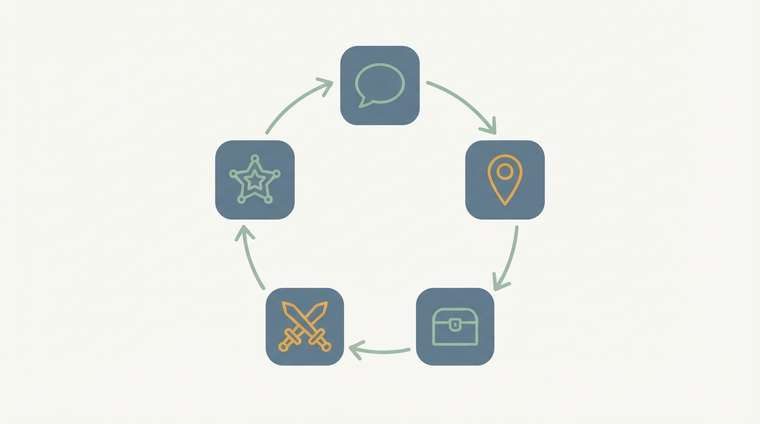
Combat games have a free pacing unit: the encounter. It resets the player's state, delivers a spike, and gives a natural place to stop. Without it, you have to build the rhythm deliberately out of beats.
The useful shape is a cycle of pressure and release. Concretely, for a prototype: something should change state within the first 30 seconds of movement; a reveal or a new area roughly every 2 to 3 minutes; something irreversible every 5 minutes; and at least one room that is only a room, with nothing to solve. The quiet section is not filler. It is what makes the next pressure beat register as pressure rather than as noise. A game that escalates continuously stops escalating, because the player normalizes to it.
The practical way to audit this is to walk your own level with a stopwatch and write down every state change — a flag, a door, a line, a counter. If you can walk for 90 seconds with nothing changing, that stretch is dead in a combat-less game in a way it would not be in a combat game.
In The Cyclops' Island, the pacing is carried by sightlines rather than encounters: you see the destination long before you can stand on it. Walk through it once with the audio muted and note how often your direction changes. That number is your pacing, and it is measurable without playing a single fight.
A Concrete Build Order for an RPG Without Combat
Four objects. Not four systems — four objects in one scene. This is deliberately smaller than you think it should be.
Step | Deliverable | Pass condition before moving on |
|---|---|---|
1 | One room | Player can see every exit from spawn |
2 | One character with a want | Player can restate the want in their own words |
3 | One non-combat obstacle | Player can name the obstacle and one way to attack it |
4 | One ending, which can be a refusal | Player reaches it unaided and can describe how |
One room
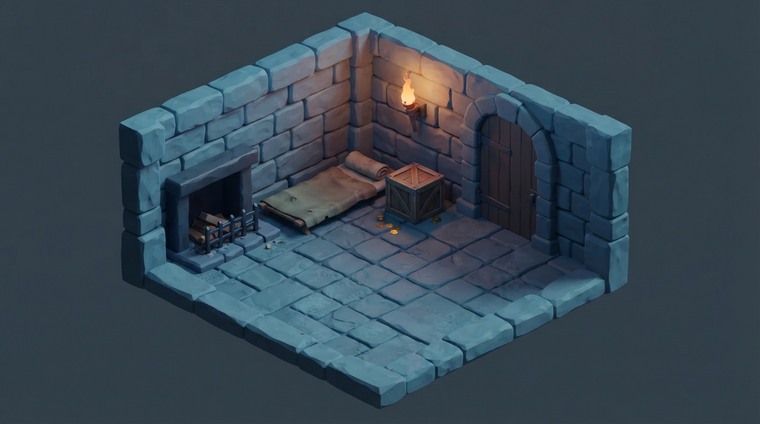
Keep it under roughly 20 by 20 units so that every exit stays inside the player's view from the spawn point. One entrance, one closed exit. The room must communicate its own shape without a minimap. If the player has to open a map to understand where they are, the room failed.
One character with a want
Not a quest giver. A character who wants something and cannot get it alone. Place them where the player will pass them, not where the player has to search. Their dialogue needs three parts: what they want, what they will trade for it, and what they will not say. The third part is what makes a second conversation worth having.
One obstacle that is not a fight
Pick exactly one: a locked mechanism, a weight the player cannot lift, a distance the player cannot cross, a time window that closes, a permission the player does not have, or information the player does not know. Each of these is a script and a trigger. None of them is a damage formula.
One ending
The prototype ends when the want is resolved or refused. Refusal has to be a real ending, with its own closing beat, otherwise the player will assume they missed something and keep searching. Measure the run time from spawn to ending. Under 60 seconds and you have a demo, not a loop. Past 10 minutes in a single room and you have built a walking sim, which brings us to the failure modes.
The Three Failure Modes of an RPG Without Combat
Failure mode 1: it becomes a walking sim
Symptom: the player walks, looks at things, and no state changes. They are not bored because nothing is happening on screen — plenty is happening on screen. They are bored because nothing they do alters anything.
Diagnosis: you built space, not consequence. Fix: every room changes at least one flag, one counter, one door, or one line of dialogue that later matters. If a room has no state change, either cut it or give it one.
Failure mode 2: the goal is unclear
Symptom: a playtester, unprompted, asks what they are supposed to be doing. Diagnosis: the goal exists in your head and in a design document, but not in the world. Fix: the goal has to be visible as an object, a locked door, or an NPC who states it plainly and then states it again the second time you talk to them. Saying it once is not enough; players are reading the room, not your intent.
Failure mode 3: nothing pressures the player
Symptom: the player does everything, in any order, at their own pace, and never has to give anything up. Diagnosis: no cost anywhere in the loop. Fix: something must be lost by acting, or by waiting. The rising tide, the burning lamp, the NPC who leaves if you take too long. Pressure is the part beginners skip, because pressure feels like it is punishing the player. It is not. It is what makes their decisions mean something.
Refusal endings are the fastest way to find out whether your pressure is real. Give the player a way to say no to the central want, and watch how many take it. If nobody refuses, your cost is too low to be felt. If everybody refuses, your goal is not legible enough.
How to Test the Loop Before You Add Anything
Do not add combat until the four-object prototype has been walked by at least three people who have not been told anything about it.
What you watch for:
- Time from spawn to first deliberate action. If a tester stands still for more than a few seconds, your room is not communicating an affordance.
- Whether they can restate the character's want in their own words. Paraphrase is the test, not repetition.
- Whether they can name the obstacle and describe at least one approach to it. If they describe the obstacle as "I need to find the key", you have built a lock, not a problem — that is fine for a prototype but it is the shallowest version.
- Whether they reach the ending without help, and how long it took.
- Whether they ask for a fight.
That last one gets misread constantly. Testers asking for combat usually means the loop is inert, not that combat is required. They are asking for a verb that produces a reaction. Fix the reaction. Add a state change, a cost, a consequence. If they still ask for a fight after the loop produces consequences, then you have a design decision to make, and you will be making it with information instead of habit.
Keep a running note of every moment a tester says "what do I do now" and where they were standing. That list is your level design TODO, and it is more useful than any amount of internal playtesting.
Why a Browser Builder Makes the Prototype Testable This Week
The build order above is four objects. Four objects is an afternoon of layout, one dialogue script, one trigger, and one ending volume. That is the entire cost of finding out whether your concept holds up.
A browser-based builder removes the parts that used to make this expensive. There is no install and no engine project to configure, so the time between "I want to try a version where the tide is faster" and playing that version is minutes rather than an evening. Sharing the build for testing is a link, not a build artifact and a set of instructions. You can run three testers through it in a day and change something before the fourth.
Agent Sprite Forge handles the character art problem, which otherwise stalls these prototypes at exactly the wrong moment. A readable character in the scene is worth more than a well-written NPC who is currently a capsule. And the 3D game builder handles the room, the trigger volumes, and the dialogue state without you writing a state machine from scratch.
If you want a reference for how exploration pressure reads in practice, walk through Mini World or The Cyclops' Island before you build. Both are playable in the browser and both will show you how much of the work is done by layout and sightlines rather than by systems.
Start by Removing the Attack Button
The argument is narrow. Combat is not bad. Combat is expensive, it is the least differentiated thing in your project, and building it first prevents you from finding out whether your world, your characters, and your pressures are doing anything. Build the four objects first. Test them on three people. If the loop holds without combat, you have a game with an identity and you can add combat later from a position of strength. If the loop does not hold, combat would not have saved it — it would only have hidden the problem for another three weeks.
Open the builder, make one room with one character who wants something, and see whether a stranger can tell you what that thing is. That is the whole test. If you want the longer walkthrough, the guide covers the same build order step by step, and the builder is where you run it.
Keep going
- /explore/tool/rpg-creator
- /explore/guide/how-to-make-an-rpg
- /explore/guide/rpg-types
- /explore/guide/ai-game-master
- /explore/tool/ai-rpg-generator
- The Cyclops' Island
- /explore/rpg-game
- /explore/guide/rpg-game-engine
Build the world it walks in
A character, a tile or a model is a material with nowhere to stand. Every world on the 3D game builder was made from one written description and published as a page you can play — including Mini World and The Cyclops' Island.