AI NPCs: How AI-Driven Non-Player Characters Work (and How to Build One)
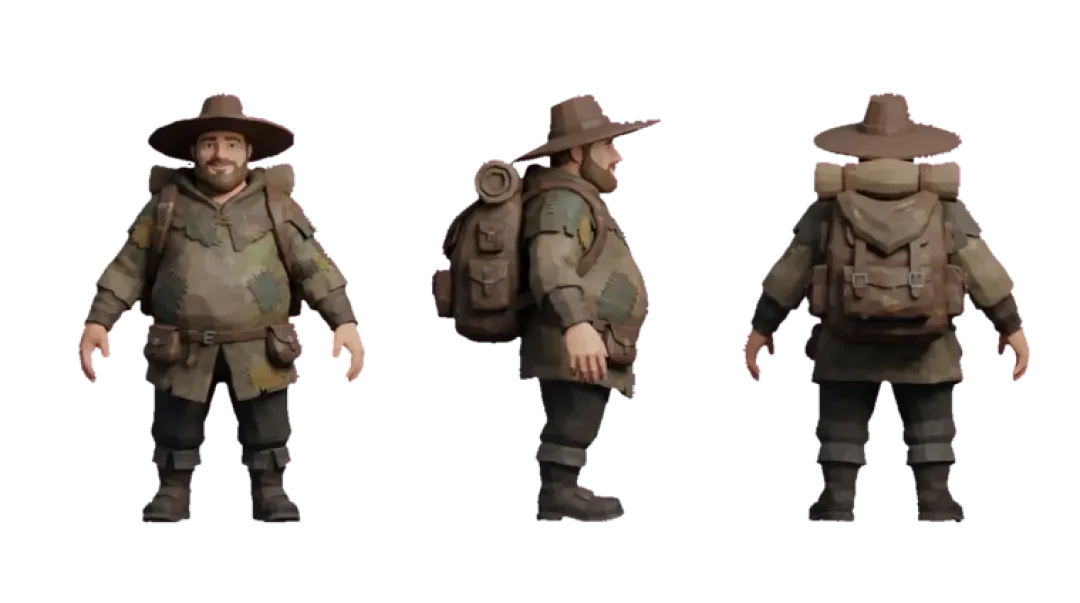



Make your own ai npc
Artificial intelligence NPCs can talk, remember and react. Learn how AI NPCs work, then build one in a sentence and drop it into a walkable 3D world.
An AI NPC is a non-player character whose dialogue and intent are produced by a language model at runtime, while movement and collision stay on a deterministic path. The AI drives what the character says and wants; the engine drives where the body goes. On Neta Studio, you describe a character in one sentence, the Agent Sprite Forge emits a low-poly component, and that component drops into a walkable 3D world built on Three.js.
That split matters because it tells you where bugs live. When an NPC walks through a wall, the pathing is wrong. When an NPC insults the player unprompted, the prompt contract is wrong. This page covers the second category: how ai npc systems generate lines, hold personality parameters, remember a session, and fail when the model plans and the engine cannot execute.
Quick Answer: What an AI NPC Actually Is
Split the phrase. "AI" here means a model produces text and a high-level intent. "NPC" means a character controller, a collider, and an animation state machine. The two run on different clocks: the model answers in hundreds of milliseconds, the controller updates every frame at 60 Hz. They talk to each other through a narrow interface, usually a small JSON object the controller polls.
In practice the interface looks like this: the model returns {line, intent, target}. The controller reads intent, checks whether the target is reachable on the navmesh, and either plays the line with a matching animation or substitutes a fallback line. If you merge those two layers, you get NPCs that teleport, slide, or stand still mid-sentence while the model finishes generating.
So the working definition: an AI NPC is an NPC whose spoken output and next-action selection come from a generative model, bounded by a fixed set of legal intents the engine can actually perform.
- Dialogue layerModel call. Latency 200–900 ms. Can fail, rate-limit, or return malformed JSON.
- Intent layerA short enum: greet, follow, flee, trade, attack, idle. Anything outside the enum is discarded.
- Movement layerNavmesh pathing, collider, animation blend. Runs every frame. Does not call the model.
- Memory layerA key-value store of facts the NPC is allowed to recall, capped by token budget.
Rule-Based vs AI-Driven NPCs
A rule-based NPC picks from a table. You author the states, transitions, and lines by hand. It is exact, cheap, and reproducible: the same input always produces the same output, which makes it trivial to test and trivial to debug. The ceiling is your writing time, and the failure mode is a player typing something you did not anticipate and getting a blank stare.
An AI-driven NPC generates the line. You author a contract and a set of legal intents, and the model fills the space between them. It handles unanticipated input gracefully, but the same input may produce different output across two runs, which breaks naive replay tests. Cost scales with conversation length rather than with character count, so a chatty scene costs more than a silent one.
Neither is strictly better. The honest comparison:
| Dimension | Rule-based NPC | AI-driven NPC |
|---|---|---|
| Behaviour source | Authored state machine and line table | Model output constrained by an intent enum |
| Replayability | Bit-identical across runs | Non-deterministic unless you pin seed and temperature |
| Cost shape | Fixed at build time | Per-token at runtime, grows with conversation length |
| Debuggability | Trace the transition; the log is the code | Log prompt, raw response, parsed intent, and fallback separately |
| Failure mode | Blank or wrong-branch response | Off-contract line, latency spike, or unparseable JSON |
| Authoring effort | High per line, low per state | Low per line, high per constraint |
Dynamic Dialogue
A dialogue tree is a graph with authored nodes. The writer controls every word, which is why quests, contracts, and plot-critical reveals still use trees. The player's input is matched to one of N branches; anything outside N is unhandled. Trees scale linearly with content: doubling the conversation doubles the writing.
Generated dialogue is different in kind, not just in volume. The model reads the player's actual sentence, plus context you inject — NPC name, current goal, last three exchanges — and writes a response that fits. It can handle a question you never anticipated. It can also handle that question badly, confidently, and in character, which is worse than failing.
Where a tree is still correct: any line that carries state the rest of the game depends on. "The gate code is 4417." Do not let a model invent that. The reliable pattern is hybrid — the tree owns facts and branch points, the model owns phrasing and small talk. In Neta Studio, when you build an AI NPC from a description, the generated component exposes an intent enum; facts you want guaranteed go into the component as fixed strings, not into the prompt as instructions.
Prompt shape that survives contact with players
Keep the system prompt under roughly 300 tokens. Role, tone, three constraints, and the output schema. Everything else — inventory, quest state, world facts — goes in a separate context block the engine injects per turn. If you put the whole world in the system prompt, latency climbs and the model starts ignoring later instructions.
Always request structured output. Ask for a JSON object with line and intent. Parse it. If parsing fails, drop the line and play the fallback. Never render raw model text directly to the dialogue box without a length check; a runaway generation will produce a 400-word monologue that breaks your UI.
Procedural Personality
A personality is not a backstory paragraph. A backstory paragraph is training data for the model's imagination, and it degrades with length: past a few hundred words the model starts treating it as flavour and drifting toward generic helpfulness. Treat personality as three or four parameters instead, each of which changes observable behaviour.
Goal is what the NPC wants right now. Tone is how it speaks: clipped, formal, mocking. Constraint is what it will not do: will not lie, will not discuss the war, will not trade. Those three fit in a single prompt line and are individually testable. Add a fourth only if you can describe what changes when you vary it.
In Neta Studio, the Agent Sprite Forge accepts a description and returns a low-poly component with these parameters exposed as fields on the component. You can edit goal without touching the model prompt, and you can clone a component and change only tone to get a second NPC. Two NPCs with the same mesh and different tone read as different characters in a scene, which is cheaper than authoring two sprites.
- GoalOne sentence, present tense. "Get the player to leave the shrine."
- ToneTwo to four adjectives. "Clipped, archaic, impatient."
- ConstraintNegative rules. "Never names the river. Never accepts an item."
- Knowledge boundaryWhat the NPC can reference. Anything outside it should produce an in-character deflection, not an invention.
Adaptive Behavior
Memory inside a session is cheap and effective. You keep a rolling buffer of the last N exchanges, plus a small key-value store of facts the NPC has been told. N of 8 to 12 works for most scenes; past that the prompt grows faster than the player's patience, and older turns stop affecting output anyway.
What an NPC can remember reliably: the player's name as stated, whether a specific item was given or refused, whether a previous interaction ended in hostility, and the last stated goal. What it cannot remember reliably: exact phrasing from twenty turns ago, facts that were never written to the key-value store, and anything across a page reload unless you persist it. Memory that lives only in the prompt is memory that evaporates.
Reaction is the second half. The engine watches state changes — health drop, item transfer, distance threshold crossed — and pushes an event into the NPC's context. The model then chooses an intent from the enum. This is why the intent enum exists: the model proposes, the engine disposes. An NPC that "decides" to attack must still pass the reachability check. If it fails, it plays a warning line and stays put.
What persistence actually costs
Writing memory to storage is one line of code and one schema decision. Keep keys short and flat: playerName, gaveItem, hostility. Nested objects bloat and rot. Version the schema from the start; a rename later silently drops old saves unless you write a migration.
Across sessions, do not attempt to replay the entire conversation history into context. It is expensive and it makes the NPC repetitive. Persist the summary — three to five facts — and start fresh with the transcript.
Build an AI NPC in One Sentence
The pipeline in Neta Studio is deliberately short. You write a description. The Agent Sprite Forge generates a low-poly component with a mesh, a palette, and a behaviour mode. You drop it into a walkable scene built with the 3D game builder, and it spawns with collision, pathing, and a dialogue hook already wired.
A working description is specific about role, tone, and one constraint. "A suspicious lighthouse keeper, clipped and north-country, who will not discuss the shipwreck." That produces a component whose prompt includes exactly those three parameters. Something like "a cool character" produces a generic result, because there is nothing to constrain.
You can test the result in two places: The Cyclops' Island, which is the long-form walkable scene, and Mini World, which is smaller and faster to iterate in. Both run in the browser on Three.js. Drop the component in, walk up to it, type a line, and read the response. If the tone is off, edit the tone field on the component rather than rewriting the prompt from scratch.
01
Write one sentence: role, tone, one constraint.
02
Run it through the Agent Sprite Forge to generate a low-poly component.
03
Open Mini World or The Cyclops' Island in the 3D game builder.
04
Drop the component into the scene; it spawns with collision and a dialogue hook.
05
Walk up and type a line. Read the response and the intent it selected.
06
Edit tone or constraint on the component, not the system prompt.
07
Test the failure path: type something off-topic and confirm the fallback fires.
08
Move the component to the larger scene once it behaves.
What AI NPCs Still Cannot Do
Long-horizon planning does not work. A model asked to plan thirty steps across a scene will produce a plausible plan and then lose the thread by step six, because nothing is holding state between steps except the prompt, and the prompt is getting longer and noisier. If you need a multi-stage quest, author the stages and let the model fill dialogue inside each stage. Do not ask it to hold the arc.
Truly open goals do not work either. "Do whatever you want" produces either paralysis or a generic helpfulness loop, because the model has no signal for what counts as progress. A goal is only usable if the engine can check whether it was satisfied. If you cannot write that check, you do not have a goal, you have a mood.
Cost control is the real gap. Per-turn cost is small; the failure is in the discussion that never ends. A player who keeps talking keeps billing. You need a hard cap on turns per interaction, a cap on context tokens, and a degradation path — after the cap, the NPC switches to shorter, canned responses. Without those three, one curious playtester can burn more budget than the rest of your scene combined.
And the smaller failures: latency above roughly 1.5 seconds reads as a broken game, not as a thoughtful character. Non-determinism breaks replay testing unless you pin seed and temperature. And any generated line can contradict something the tree already established, which is why facts stay in the tree.
- Planning horizonReliable for 1–2 steps. Degrades badly past that.
- Goal verificationMust be checkable by the engine. Otherwise the goal is decorative.
- Cost ceilingNeeds per-interaction turn cap plus token cap plus a fallback mode.
- Latency budgetUnder 1.5 s for conversational feel; above that, players assume a freeze.
- DeterminismNon-deterministic by default. Pin seed and temperature if you test by replay.
Walk into the world it belongs to
A sprite is a character with nowhere to stand. The last step is the one nobody else offers: take the sheet you just built and put it in a world someone can walk around in — a small island, a planet, a rainy street corner. Every world on this site was made from one written description and published as a page you can play.
FAQ
Are NPCs AI? +
Traditionally no. A classic NPC is a state machine with authored lines, and that is still the default in most shipped games. The term "AI NPC" refers specifically to characters whose dialogue or intent selection is produced by a model at runtime rather than picked from a table.
What is an AI NPC? +
A non-player character whose spoken output and next-action choice come from a generative model, constrained by a fixed set of intents the engine can execute. Movement, collision, and animation stay deterministic; the model only fills the dialogue and proposes an intent.
Can AI NPCs remember things? +
Within a session, yes — a rolling buffer of the last 8 to 12 exchanges plus a small key-value store of facts covers most scenes. Across a page reload, only if you persist the facts to storage. Memory that lives only in the prompt disappears when the context does.
Can I build one for free? +
The Agent Sprite Forge and the 3D game builder run in the browser and let you generate a component from a sentence without a local toolchain. Runtime model calls are the part that carries a cost, and that cost depends on which model you route to and how long your conversations run.
Do I need a game engine to build an AI NPC? +
Not for a browser scene. The 3D game builder handles rendering on Three.js and gives the generated component collision, pathing, and a dialogue hook, so you skip the engine setup step. You only need a full engine if you are targeting a native build.
Do AI NPCs work in a browser? +
Yes. The model call is a network request and the rendering is WebGL, so both sides run in the browser. The practical constraint is latency: keep the system prompt short and the context block separate, or responses start arriving after the player has already assumed the game froze.
How much does an AI NPC cost to run? +
It scales with conversation length, not with the number of characters you place. A silent NPC is nearly free; a chatty one bills per turn. The control that matters is a hard per-interaction turn cap plus a token cap, with a canned-response fallback once the cap is hit.
Back to the 3D Game Builder
All 31 finished 3D worlds, games and scenes live on one page — every one of them playable.