NPC Meaning in Gaming: What It Stands For and Why It Matters

Make your own npc gaming
What does NPC stand for in gaming, and where did the term come from? The origin, the three spellings — NPC, NPC's, NPCs — and live 3D worlds where non-player characters still do their thing.
NPC stands for non-player character: any character in a game that the player does not control. In npc gaming the label stretches across a wide range — a shopkeeper with three lines of dialogue, a guard on a patrol loop, a companion that follows you through a level — and it doubles as a category name, a shorthand for behaviour quality, and, outside games, an insult.
This page covers where the term came from, the three spellings people search for (NPC, NPCs, NPC's), how the meaning survived five hardware generations while the behaviour underneath it changed completely, and what to watch for when you stand in front of a scripted character in a live browser scene.
Quick Answer: NPC Means Non-Player Character
NPC is short for non-player character, meaning any character in a game that the player does not control. The label covers allies, merchants, quest givers, ambient crowds and hostile mobs alike, as long as nobody at the keyboard is driving them.
The abbreviation is used everywhere because it is four characters shorter than the words it replaces and fits into dialogue tables, engine class names, design docs and bug tickets — and it is ambiguous outside games, where a reader can take it as a comment about a person rather than a description of software.
Where the Term Came From
The term predates video games. It comes from tabletop roleplaying, where one participant runs the world and every character in it that is not controlled by a player. That role — game master, dungeon master, referee, depending on the system — is the original non-player character engine: it holds the shopkeeper's prices, the guard's patrol and the innkeeper's gossip in one head, and answers when a player asks.
The exact first printing of the phrase is hard to pin down, and I would not claim a specific book or year without the page in front of me. What is clear is that pen-and-paper rules text needed a word that separated the characters the players inhabit from the characters the referee speaks for, and that word was already in use in the hobby before home computers had the memory to hold a conversation.
Video games inherited the term as soon as they had characters at all. Early designers needed to separate the thing the player moves from the things that move by rules, and they took the word that already meant exactly that. It stayed a design word rather than an engine word: in Unreal the closest analogue is the Pawn and Character class hierarchy, in Unity it is a GameObject with a controller component, and neither engine ships a class literally named NPC. That gap is a useful tell — when someone says NPC, they are usually talking about intent and behaviour, not about code.
NPC, NPC's or NPCs: Which Spelling Is Right
The singular is NPC. The plural is NPCs, with a bare s and no apostrophe, which is how most editorial style guides treat acronyms. The possessive is NPC's, because the apostrophe is doing its actual job of marking possession. All three are correct in their own slot; the confusion is that two of them look almost identical at a glance.
The search variant npc's is usually a plural written with an apostrophe — the same reflex that produces "TV's" and "PC's". Occasionally it is a genuine possessive with the noun dropped, as in "the NPC's line" shortened to "the NPC's". If you are building a search index or a content filter, do not match the three forms as raw strings: normalise case, and strip apostrophes before comparison, or a query for NPC will silently miss both NPCs and npc's.
| Form | What it is | Example sentence |
|---|---|---|
| NPC | Singular. One character. | The NPC at the gate repeats the same line until you accept the quest. |
| NPCs | Plural. More than one. | The NPCs in the market run on one shared idle schedule. |
| NPC's | Possessive. Belongs to one NPC. | The NPC's patrol route loops around the well and back to the gate. |
Why Games Needed the Term
The word is a shorthand for a category, and the category is defined by an absence: no player agency. Everything in a scene is either driven by input, driven by rules, or inert. NPC names the middle case. Without it, a design document has to write "the character that walks the wall but is not controlled by anyone" every time, which is the sort of sentence that gets shortened whether you plan for it or not.
The boundary needs care in both directions. A hostile mob is technically a non-player character — nobody is driving it — but players habitually separate "NPC" from "enemy" in conversation, reserving the first word for characters you talk to. Meanwhile a crate with a physics body is not an NPC, and a crate that opens a dialogue box when you interact with it is one: it has a state and a response, even if the state is a single boolean.
That last example is the useful test. Ask what the thing does when the player is not looking. A prop does nothing. An NPC either keeps doing something on a schedule — patrolling, idling, trading — or holds state that will change once the player arrives. If it has neither, it is scenery with a model attached.
- Player characterReads input. Owns the camera, the fail state and the save file. Every other object in the scene is defined relative to it.
- NPCNo input. Driven by a script, a state machine, a schedule or a path. May still hold dialogue, inventory, goals and a record of what you did last time.
- EnemyAn NPC with a hostility rule attached. In casual speech players keep the words apart; mechanically a hostile mob is a non-player character, because nothing at the keyboard is steering it.
- PropNo decision loop and no state worth saving. A lamp post, a fence, a barrel. Add one interaction and one response and it crosses the line into scripted NPC.
How the Meaning Changed Across Game Eras
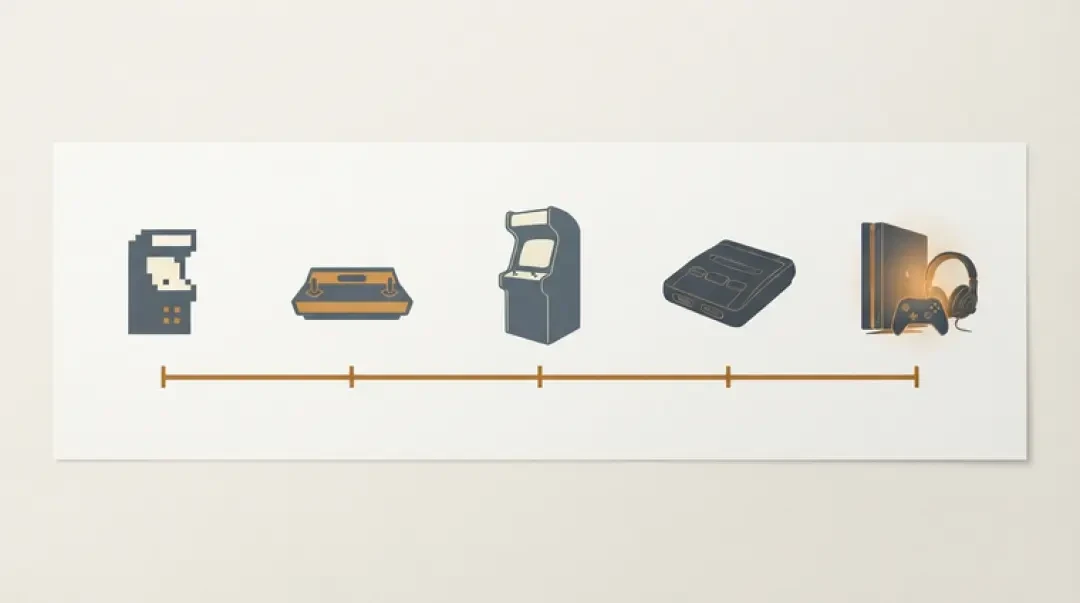
Fixed sprite dialogue. In arcade and 8-bit games an NPC was usually a sprite with one attached text string, stored in a table and pulled by a script pointer. It repeated forever, had no memory of you, and was exactly what the word still means. What changed was never the definition; it was the size of the machine behind the character.
Dialogue trees and global flags. Adventure games and 16-bit roleplaying games added branching conversation, which forced the NPC to hold state for the first time. A flag in the save file — met_guard set to true, gate_key set to false — let a character behave differently on the second visit. The character did not get smarter. The game started keeping a checklist on its behalf, and every later improvement is a bigger checklist.
Scripted open worlds. From the mid-2000s, characters got daily schedules, navmesh pathing and day/night loops; Oblivion's Radiant AI is the canonical example of both the ambition and the failure mode. When the schedule, the path and the world geometry disagree, the NPC walks into a door that is locked after dark and stands there until morning. The bug reports from that era are almost all about characters being where the designer did not expect.
Systems-driven characters. Behaviour trees and utility AI replaced the single script with a scored list of options — eat, patrol, talk, flee — evaluated every tick. The failures moved up a level. A quest-critical character who wanders into a fight and dies takes the quest with them, which is why shipped games mark those characters protected or essential rather than trusting the system to keep them alive.
The model layer. Recent games and browser tools bolt language-model dialogue onto that same skeleton: barks, navmesh, animation state machine and interaction triggers first, generated text on top. Ungrounded, the text layer invents facts about the world and contradicts the quest log. Grounded in real world state, it changes what the character says and not what it can do — which is the same division of labour the 8-bit text table had.
Play a World Where NPCs Still Do Their Thing
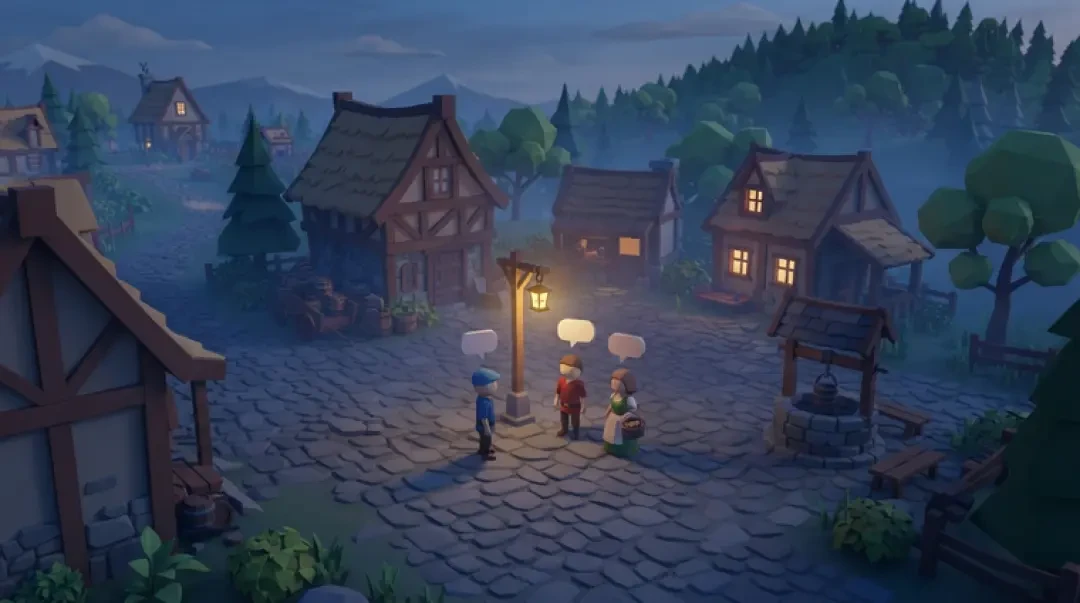
Reading about behaviour is less useful than standing in front of it. Open the 3D game builder and load Mini World for a compact scene, or walk The Cyclops' Island for a larger space with characters placed through it. Walk rather than run: most character bugs are only visible at walking speed, where you can see a model slide across the ground instead of stepping, or turn on the spot because its facing target and its path disagree.
Four properties separate a scripted character from a decorative one: whether it notices you, whether it initiates, whether it remembers, and whether it can fail. A guard that rotates to face you as you approach is running a proximity trigger. A merchant who speaks first has an interaction radius set wider than the character's collision. A character who repeats the identical first line on the second visit has no state at all — the dialogue table was indexed by a constant.
If you are building rather than touring, the description you write is the spec the builder works from. "A gate guard who repeats one line until the gate opens" and "a merchant who follows you at three metres and stops when you stop" describe the same model and two different systems; the second needs a follow target, a stopping distance, and a rule for what happens when the path is blocked by a fence. Describe behaviour, not just appearance, or you will get a well-modelled character with nothing to do.
What NPC gaming looks like when it is working
A scene reads as inhabited when different characters are doing different things on different clocks. Three characters all idling on the same two-second loop read as a texture, not a population. One character on a twenty-second patrol, one that turns to track the player, and one that does nothing at all until spoken to gives the eye three separate things to notice.
01
Load the scene and stand still for ten seconds before moving. Idle characters reveal their loop: who shifts weight, who repeats the same two-frame animation, who does literally nothing.
02
Approach each character slowly and watch the head. Characters that turn to face you are running a look-at or proximity trigger; characters that keep their back turned have no awareness state at all.
03
Talk to whoever speaks first, then walk away and come back. If the second conversation is identical to the first, nothing was written to state — the character is a text table, not a system.
04
Try to break a patrol. Stand in the path of a walking character and see whether it stops, steps around you, or walks through. Walking through means no avoidance is configured on the navigation agent.
05
Change one thing about a character description — follow distance, patrol route, greeting line — and reload. Watch whether the change shows up in behaviour or only in appearance, which tells you which layer your edit actually reached.
NPC Meaning Outside Games
Outside games the word gets used loosely, and usually unkindly, to describe a person who seems to be reciting lines rather than thinking — someone repeating a stock opinion, or following a routine with no visible goal. The metaphor borrows the game meaning directly: scripted, predictable, no agency of their own. There is also the streamer sense, where a creator performs as a character reacting to viewer gifts, which borrows the visual grammar of a game character standing in one spot.
Game writers tend to avoid the word when they mean a character with a goal, because it describes who controls a character, not what the character wants. In a design document, "NPC" answers a question about input. It says nothing about motive, and a scene written from the category label alone produces exactly what the label implies: a character standing still, waiting to be used.
Walk into the world it belongs to
A sprite is a character with nowhere to stand. The last step is the one nobody else offers: take the sheet you just built and put it in a world someone can walk around in — a small island, a planet, a rainy street corner. Every world on this site was made from one written description and published as a page you can play.
FAQ
What does NPC stand for in gaming? +
Non-player character — any character in a game that the player does not control. It covers quest givers, merchants, companions, crowd members and hostile mobs, because in all those cases the behaviour comes from a script or a system rather than from input.
Is it NPC or NPCs? +
Singular is NPC, plural is NPCs with no apostrophe, and the possessive is NPC's. The search variant npc's is nearly always a plural typed with an apostrophe, which is nonstandard but common enough that any index or filter should normalise it rather than reject it.
Where did the term come from? +
Tabletop roleplaying, where the game master runs every character that is not a player's. Video games adopted the phrase early because they needed the same distinction between the avatar and everything else, and it survived into engine work and design documents unchanged.
Is an enemy an NPC? +
Mechanically yes — a hostile mob is a non-player character, since nobody is driving it. In everyday speech players usually split the two, using NPC for characters you talk to and enemy or mob for characters you fight, which is why the word can seem to mean two things in the same conversation.
What is the difference between a player and an NPC? +
The source of control and who owns the consequences. The player character reads input, carries the camera and the fail state, and writes the save file. An NPC is driven by a script, state machine, schedule or path, and its memory of you exists only because the game is keeping it.
Are all NPCs AI-driven? +
No. Plenty are pure script: a fixed patrol, a trigger volume, a dialogue table indexed by a constant. Even the ones that use AI in the game-development sense — behaviour trees, utility scoring, navmesh pathing — are rule systems with no learning in them, so the word AI means something narrower here than it does in general use.
Back to the 3D Game Builder
All 31 finished 3D worlds, games and scenes live on one page — every one of them playable.