
JRPG Pacing: Why Older JRPGs Still Feel Better to Play
The complaint sounds like nostalgia, so it usually gets dismissed as nostalgia. It isn't. Sit someone down with a cartridge from the early nineties and the thing they notice in the first twenty minutes is not the sprite count or the tinny audio. It's that the game never makes them wait for permission to play. That observation is measurable in seconds, and it is the whole argument: JRPG pacing — why older JRPGs hold up — is a property of four mechanical budgets, not a property of memory. The loop, the encounter budget, the menu latency, and the fight length. All four are numbers a designer sets. All four were set conservatively, by accident or by hardware constraint, in a period when a game could not afford to waste the player's attention. Modern tools let us spend that attention lavishly. That is where the rhythm went.
This is a craft essay, not a data report. The claim is narrow: the durability of older JRPGs comes from the fact that their pacing budgets were small and legible, and a player could feel them without being told.
The Four-Beat Loop: Town, Road, Dungeon, Save
The classic structure is four beats, and each beat has a different job. Not a different look — a different job. When the jobs blur, the loop stops teaching the player where they are.
Beat | Job | Player's question | Healthy length | Failure mode |
|---|---|---|---|---|
Town | Restock, information, tone | "What do I need before I leave?" | 3–6 min | A menu with a backdrop; nothing to learn, nothing to buy |
Road | Test the build at low stakes | "Is my party working?" | 5–10 min | Traversal with no decision — a corridor with grass |
Dungeon | Drain resources, pose a spatial problem | "Can I afford one more room?" | 15–25 min | A straight line with a boss stapled to the end |
Save | The exhale | "Can I stop here?" | 1 screen | Autosave everywhere, so there is nothing to exhale at |
The loop works because the verbs alternate. Town is talk and menu. Road is fight and loot. Dungeon is navigate and manage. Save is stop. Four different modes of attention in sequence, each one resting the muscle the last one used. That alternation is the reason a thirty-hour game stays readable: the player is never doing the same thing for more than about twenty-five minutes.
The most common modern failure is merging the town into the road. If the town has no shop worth visiting and no NPC who tells you something you'll use, then the town is a loading screen with a music cue, and the player is now doing road things for twice as long.
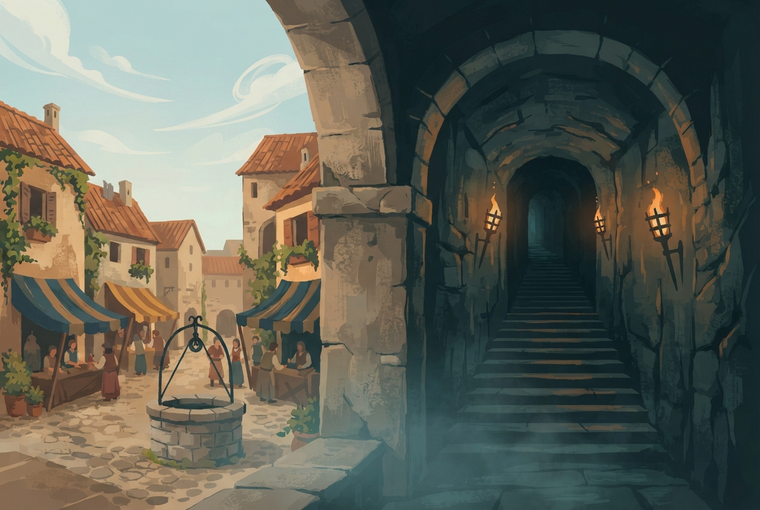
The Encounter Budget: Why Older JRPGs Feel Fair
Random encounters are not the problem. Invisible budgets are.
The old model was a step counter. After each battle, the counter resets, a threshold is rolled inside a range, and the next fight fires when you cross it. The player never sees the number, but within about ten fights they have built a working model of it: "roughly eight steps, then a fight." That model is what makes a random encounter feel fair. The randomness is bounded, and the bound is tight enough to learn.
Compare that to a modern spawn system driven by a radius and a respawn timer. The enemy is visible, which feels honest, but the rule is not: you cannot tell whether walking back through a room you cleared thirty seconds ago is safe. You cannot tell whether the room you're avoiding in order to save HP is costing you the XP you need for the boss. The information you need to plan is hidden, and the thing that's visible is the least useful part.
Bravely Default is the clean version of the argument: it hands the encounter rate to the player as a setting, including zero. The point isn't that zero is good design. The point is that the game admits the encounter rate is a budget and lets you see it. EarthBound shows enemies on the field and lets you auto-win fights against things far below your level, which is a different way of saying the same thing: the budget is a number, and the player is allowed to know it.
The rule I use: roll the step threshold between a floor and a ceiling no more than two to one apart — 120 to 240, not 40 to 400. The wide range is what players describe as "unfair," even though the average is identical. And never fire an encounter within two seconds of a zone transition or a save prompt. Being ambushed the instant you load a screen reads as a bug, not as danger.
Two more constraints that are cheap and matter more than they look: don't fire an encounter on the frame after a menu closes, and don't fire one during the first second of a new screen. The player needs a beat to re-orient. Taking that beat away is how a fair budget still feels hostile.
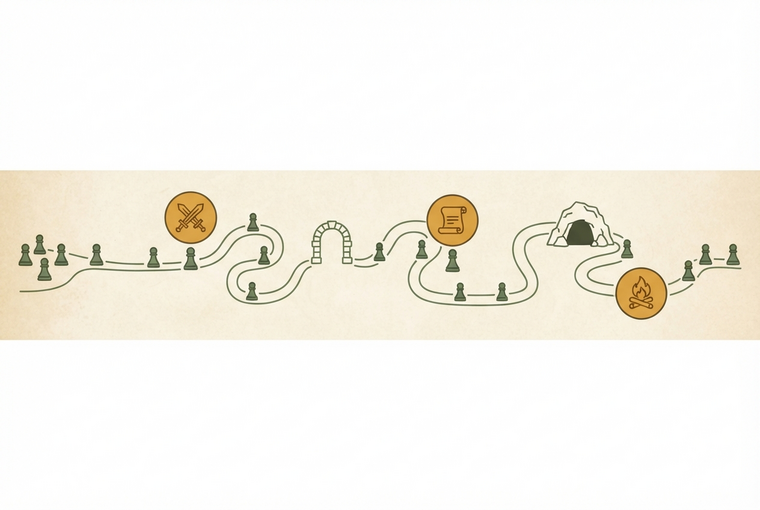
Menu Speed: Where Thirty Hours of Waiting Comes From
Here is a fight. Four party members, four Attack commands, one enemy that dies on the second round. In a good build, the full cycle per character — read the menu, move the cursor, confirm, see the number — runs about 1.5 seconds. In a build that has been over-produced, that same cycle runs six.
The gap is not cosmetic. Do the arithmetic on your own game: if it contains a thousand fights and each fight adds three seconds of menu friction, you have inserted about fifty minutes of pure waiting into a thirty-hour experience. Nobody experiences that as fifty minutes. They experience it as the moment, around the fortieth fight of a session, when the game stops being a game and becomes paperwork.
Where the seconds go:
- Sub-menus that require a confirm to open and a confirm to close.
- A battle intro animation that replays every time, unskippable, for the first three seconds.
- Damage numbers gated behind a wind-up animation instead of landing within roughly 300 milliseconds of the input.
- A camera sweep before the enemy acts.
- A voice line that must finish before the next command is accepted.
- The cursor defaulting to the first slot in an unordered list instead of on Attack.
Fix the last one first. Default cursor position is free to change and it removes a cursor move from every single turn of the entire game.
The principle: a 1.5-second decision keeps a thirty-hour game readable because the player can hold the rhythm in their head. A six-second decision destroys the rhythm, and once the rhythm is gone the player starts evaluating the game instead of playing it. The fortieth fight is the one that decides whether they finish. Design for the fortieth fight. The first fight will be fine no matter what you do to it.
Battle Length as a Promise
A normal fight should be shorter than the walk between two fights. That's the whole rule, and it's a promise about the ratio of cost to reward that the player learns in the first ten minutes and never stops checking.
Concretely: a normal fight lands somewhere around 20–35 seconds; the walk between two of them runs 30–60. The fight is a transaction, the price is known, and the reward — XP, an item, progress toward the next level — arrives before the player gets bored of paying.
Break that promise once and the road dies. A single random encounter that drags to ninety seconds because it rolled a defensive enemy with a heal, and the player stops trusting the road. They start avoiding it, hugging walls, using Repel-equivalents, running from fights they could win. You have taught them that your combat is a tax, and now they are tax avoidance specialists.
Symptoms that a normal fight has quietly become a boss:
- You heal during a fight you are obviously winning.
- The enemy has more than two meaningful states.
- You see the same battle background transition more than once in a single fight.
- You use a consumable you were saving.
The boss, meanwhile, should be the only place the rules change. A boss is where the player must re-read the system: a new element, a phase that invalidates the buff they've been leaning on, a target priority that isn't the biggest thing on screen. That's the entire job. If the rules change in ordinary fights, the boss has nothing left to do, and the player has no way to know which fight matters.
The test I run on a build: if a normal fight ever requires a second heal, it is a boss. Either cut its HP by about 40 percent, or move it to the end of the dungeon and give it a phase change so it earns the length. Do not leave it in the middle of the road wearing a normal-fight costume.
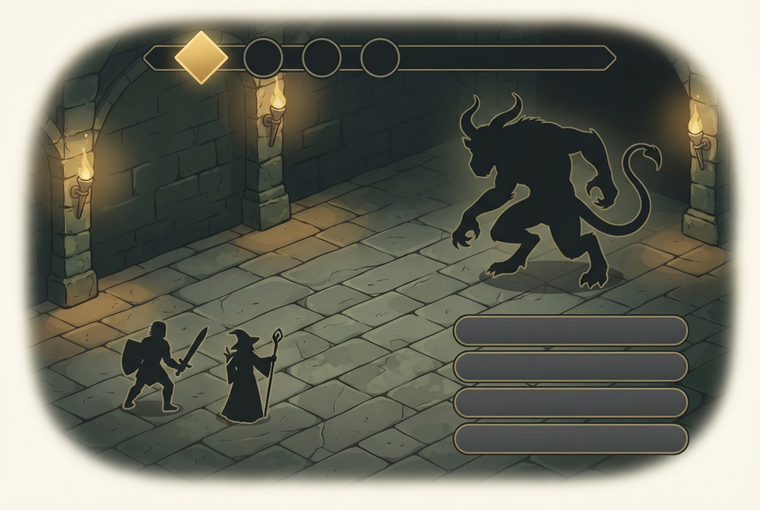
What Modern JRPGs Gained, and What the Gains Cost
Be fair to the modern build. The gains are real and most of them are unambiguously good.
Authoring tools are the big one. Camera rails, cutscene sequencing, animation blending, voice capture, lighting passes — a small team can now direct a scene that would have been impossible to stage in a tile-based engine. Set-piece direction is a genuine craft improvement; the memorable moments in recent games are memorable because someone could actually frame them. Quest logs mean the player no longer has to hold twelve NPC lines in their head. Autosave means a crash costs minutes instead of hours. Fast-forward, encounter toggles, difficulty options, suspend saves — all of it is respect for the player's time, and none of it is the problem.
The problem is that three of these gains quietly deleted a beat.
Cutscenes before agency. If the player's first meaningful decision arrives at minute twelve, the game has spent twelve minutes teaching them that they are watching. They will keep watching, and they will be slower to re-engage when you finally hand them the controller. Front-load a ninety-second playable beat — even a walk with one choice in it — before the first long scene. The player needs to know what the game feels like in their hands before you ask them to care about who is talking.
Quest markers that remove the town beat. The town beat's job was never navigation. It was preparation and tone: you find out what's ahead, you buy the thing that helps, you overhear something that makes the place feel like a place. A marker answers "where do I go" instantly, which means the only remaining reason to talk to anyone is to fill a log entry. Strip the marker and the town comes back, but only if the town contains information the player actually needs.
Difficulty spikes replacing curve. A curve teaches the same lesson across six fights at rising pressure: here is what a fire enemy does, here is what two of them do, here is what they do when they're faster than you. A spike is one fight that requires a strategy the game never taught, placed at a chokepoint. The spike feels like content because it's hard. It's actually a gap in the teaching.
Autosave deserves its own note, because it removed something nobody thought was load-bearing: the exhale. The save beat was never about the save. It was about the player being told, by the game, that this is a reasonable place to stop. Autosave everywhere means every moment is equally stoppable, which means no moment is a natural stopping point, which is part of why sessions with modern builds tend to run long and end abruptly rather than short and deliberately.
Three Ways a Session Actually Breaks
Most pacing failures are one of three, and they're easy to identify once you're looking for them.
The first is latency stacking. Menu time plus animation time plus transition time, none of them individually offensive, summing to something the player feels as slowness without being able to name it. You fix this by measuring, not by taste.
The second is beat collapse. Town and road merged. Road and dungeon merged. Dungeon and boss merged. The player is doing one thing for forty minutes and the game has stopped offering a change of mode.
The third is unearned variance. An encounter that takes four times as long as the median, a boss that requires information the player could not have had, a spawn rule the player can't model. Variance is fine when it's bounded and legible. Unbounded variance is what players mean when they say a game "wastes their time" — they're describing a distribution they can't plan around.
The Builder's Test: Time the Loop, Count the Decisions
Run this on your own scene before you add another asset. It takes an afternoon and it will save you a month.
Step one: stopwatch the loop. From the frame the player enters the first town to the frame they leave the first dungeon. Write the number down. If the first loop runs past twenty-five minutes, cut the dungeon by a third. The first loop is a promise about the whole game's scale; if it's bloated, the player extrapolates and puts the controller down.
Step two: count decisions per minute. Sit behind a player with a tally counter. Mark every input where the player has to think — a purchase, a target choice, a route choice, a party swap. Not movement. Not menu traversal. Under two decisions per minute and you have built a cutscene with a walk cycle. Over twelve and you have built a menu simulator with a story attached. Somewhere in the four-to-eight range, in town, is comfortable.
Step three: measure menu latency directly. Time ten consecutive Attack confirms and divide. Anything north of about 2.5 seconds average means your combat is a rhythm the player cannot internalize, and no amount of animation polish will fix it.
Step four: ask the player to predict the next encounter. If they can't — if they have no working model of when a fight is coming — your budget is either too wide or too invisible.
Then cut everything that isn't a decision. Not shorten — cut. A fade, a confirmation prompt, an unskippable line of flavor text before a shop menu, a "you got 12 gold" window that requires a button press. Every one of those is a place where the player is waiting rather than choosing, and the accumulated total is what they remember as the game being slow.
If you're building in Neta Studio, do the timing pass in Mini World before anyone makes art. A grey-boxed town, a road, a dungeon, and a save point is enough to measure all four budgets, and it's the cheapest version of the scene you will ever have. The Cyclops' Island is a useful reference for the shape at a scale you can hold in your head — town, road, dungeon, save, each beat doing its own job. Then bring Agent Sprite Forge in to get sprites on screen so the loop is genuinely playable before it is genuinely pretty.
The playtest note I trust most is not a rating. It's "I stopped for the night at the save point." If nobody stops at your save point, you don't have a save beat — you have a checkpoint. Those are different things and players can tell.
Older JRPGs hold up because their budgets were small, and small budgets are legible. The player could feel the loop, feel the encounter counter in their hands, feel the cost of a turn, feel the promise that a normal fight is short. None of that required technology we've since lost. It required a designer who was not allowed to spend the player's time freely, and who therefore spent it carefully. You can still choose to spend it carefully. That's the whole test.
Keep going
- the 12 RPG types, each with a playable example
- the RPG engine comparison
- how to make an RPG in four steps
- running a session with an AI game master
- the RPG creator
- the free RPG maker breakdown
Build the world it walks in
A character, a tile or a model is a material with nowhere to stand. Every world on the 3D game builder was made from one written description and published as a page you can play — including Mini World and The Cyclops' Island.