Games Made With an AI RPG Creator — Playable RPGs You Can Try Right Now
Make your own games made with rpg maker
Real RPGs and visual novels made with an AI creator — play each one in your browser, then make your own. No engine, no download.
Games made with RPG Maker taught a generation that a small map, a clear goal, and a few lines of dialogue are enough. The same constraint applies when you describe a game to an AI creator. You write a description. The system generates a real Three.js world with geometry, collision, lighting, and a state machine for characters. You get a link.
The games on this page are not demos of a tool. They are small, playable RPGs and visual novels that began as a paragraph of text and now run in a browser tab. Each one can be entered from this page. Each one can be finished in a single sitting.
Quick Answer
Every game listed here started as a written description, not a sprite sheet. The description named a space, a goal, and one or two characters. The AI creator generated the rest: floor planes, wall colliders, a third-person camera, an interaction radius, a dialogue runner, and a win condition. What ships is a URL. No executable, no installer, no engine runtime.
That last part matters for how you try these. There is no download step. You open a link, the scene loads, and you are inside it. The same is true for the builder itself. If you want to make one, the path is one sentence, one generation pass, and one play test.
These are RPGs in the older sense of the term: a space you move through, a character who wants something, and a goal you can reach. They are not hundred-hour campaigns. They are closer to the length of a good short story, which is what makes them finishable and what makes building one realistic.
What These Games Have in Common
All of these games have three things: a small authored space, one clear goal, and characters with something to say. The space is usually one map, not a world map with exits. The goal is stated in the first thirty seconds, either by an NPC or by the scene itself. The characters have a fixed set of lines that unlock in order as you progress.
That shape is not an aesthetic choice. It is what makes a game finishable. A small space means every object can be authored with intent. One goal means the player never has to wonder what the game is about. Characters with dialogue mean the goal has a reason. When you remove any of the three, the game either becomes a tech demo or a grind.
The technical reason the shape holds is that generated worlds have a finite budget. A single scene with a few hundred objects loads in under two seconds on a mid-range laptop. Scale that to a world map with ten connected scenes and you are streaming assets, managing transitions, and debugging save state. The small-space approach avoids all of that. It is the same reason a first RPG Maker project should fit on one map.
Why small spaces load fast and finish cleanly
A generated scene in Neta Studio is a Three.js scene graph with instanced geometry where possible. A room with forty distinct meshes and one character rig sits well under the memory ceiling of a mobile browser tab. Add a second connected area and you either preload it, which doubles memory, or stream it, which introduces a visible hitch on entry. Most of the games here stay in one area and use dialogue to imply the rest of the world.
This is also why the finish rate is higher than you would expect. The player sees the whole map in the first minute. They know where the exit is. The only unknown is whether they can reach it, which is the part that is actually fun.
Interactive Worlds
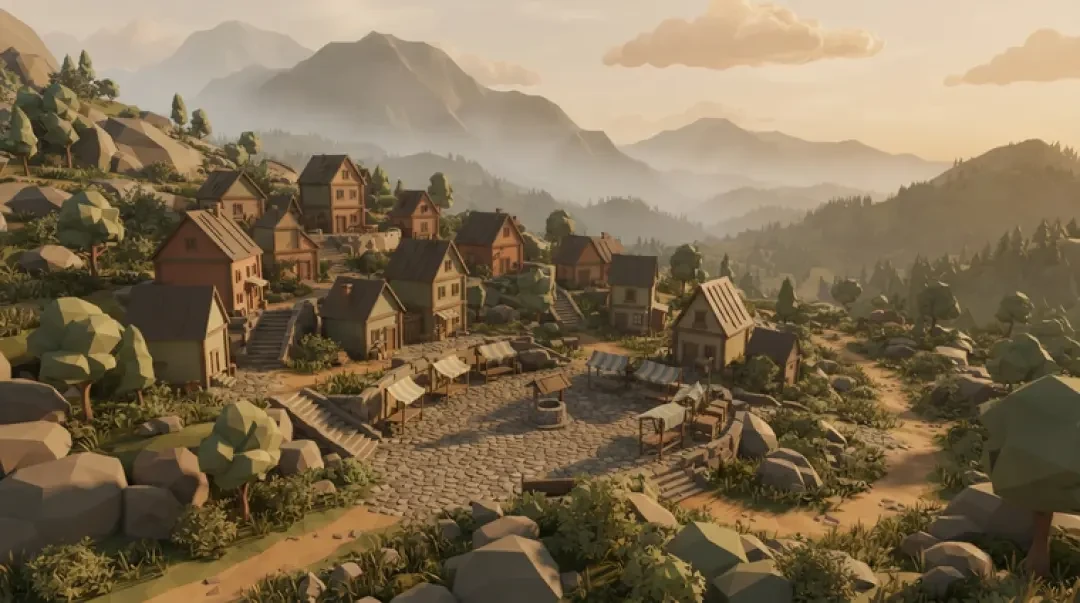
The 3D exploration games are the clearest evidence of what the AI creator does. Each one began as a description that named terrain, a goal, and a character. The generated result is a walkable Three.js world with a third-person camera, collision on the major geometry, and a win condition tied to a specific position or interaction.
The Cyclops' Island is the most direct example. The starting description was a rocky island with a single inhabitant, a cyclops who blocks the only path off the beach. The generated world is a small island with vertical rock formations, a shoreline, and a cyclops placed at the narrow pass. The goal is to get past him. The dialogue with the cyclops is the only puzzle. Finish it and you are done in a few minutes.
Mini World is the smaller, faster counterpart. The description asked for a compact explorable space with a single objective and no combat. The result is a single room-scale area with a few interactable objects and a clear exit. It is the kind of thing you would build in RPG Maker on a single map, but you walk through it in 3D and the only thing you downloaded was a page.
The 3D game builder is the tool that produced all of these. It takes a description, generates the scene, and exposes the settings you actually need: player speed, camera distance, interaction radius, and a win condition. You can open any of these games, look at the scene, and see what the description produced. That is the point. The evidence is the game itself, not a video.
What a generated scene actually contains
When the builder generates a scene, it produces a scene graph with a ground plane, instanced props, a directional light, a third-person camera rig with a follow distance of about three meters, and a character controller with a collision capsule. It also produces a state machine for each named character: idle, talking, and a post-dialogue state that changes the character's behavior or opens a path.
The failure modes are predictable. If the description mentions a large open space with no landmarks, the camera has nothing to push against and the scene feels empty. If it mentions more than three named characters, dialogue branching becomes hard to test. If it mentions combat without specifying a health model, the generated result defaults to no combat at all. The descriptions that work are the ones that describe a place, not a genre.
Visual Novels & Story Games
The dialogue-driven games are the largest group here, and that is not an accident. A visual novel or story game is the shortest path from an idea to a playable thing. You need a background, a character portrait or a 3D stand-in, and a sequence of lines. The builder generates the background as a scene, places the character, and runs the dialogue. There is no pathfinding, no combat balance, no inventory to manage.
This is also why so many of our releases sit here. The generation step is fast because the scene is simple. The testing step is fast because the only variable is the dialogue order. If a line lands wrong, you change the line, not the level. That short loop is what lets someone go from description to playable in one sitting.
The visual novels use the same 3D scene pipeline as the exploration games. The camera is locked to a fixed position or a slow orbit instead of a follow rig. The character is a 3D stand-in with a dialogue state. The rest is the same: a scene, a state machine, a set of lines. You are looking at a rendered space while the story runs, which is a different feel from a static background, and it is the reason these are worth playing rather than just reading.
Why dialogue-first is the fastest thing to build
A dialogue scene has one moving part: the line order. The builder generates the environment, the character placement, and the camera. You write the lines. When you test, you are testing whether the lines make sense in sequence, which is a reading task, not a debugging task. That is why a first project should almost always be a dialogue scene.
The constraint is that dialogue scenes live or die on the writing. A generated background cannot carry bad lines. The games here that work are the ones where the character wants something specific and the lines reveal it in order.
Character-Driven Examples
Some of the games here have no map to speak of. They have one character, one task, and a few lines. Agent Sprite Forge is the clearest case. The description named a single character with a job to do and a small workspace. The generated result is a compact scene with that character, a set of objects to interact with, and a task that can be completed in a few minutes. The hook is the character, not the space.
What makes that enough is that the character has a specific want. A character who wants something gives the player a reason to interact. A character who exists to deliver exposition does not. In these games, the interaction itself is the reward: you talk to the character, the character responds differently depending on what you have done, and the task completes when the character is satisfied. That is a complete loop.
This is the same principle behind RPG Maker's most memorable moments: a single NPC in a single room who changes what they say after you do something. It costs one variable and one conditional branch. In a generated scene, it costs one line in the description. The scale is different, but the mechanic is identical.
- One character, one wantThe character has a stated goal and reacts to whether you have helped. The dialogue state machine switches lines based on the task state.
- One task, no inventoryYou interact with a small set of objects in a small space. There is no inventory screen, no equipment, no stats. The task is the whole game.
- A finish line you can seeThe task completes when the character's state changes. That is the win condition, and it is visible from the start.
Neta Studio vs RPG Maker
RPG Maker and a browser-based AI builder are different tools for different jobs. RPG Maker has been around for decades. It has a huge asset ecosystem, a scripting layer, and a plugin community that has solved most of the problems you will hit. If you want a 2D top-down RPG with a battle system, a menu, and a save file, RPG Maker is the right call and it will stay the right call.
The browser builder wins on three things: there is no install, the output is 3D, and the deliverable is a link instead of a build. You do not configure a runtime, you do not export an executable, and you do not ask someone to download anything. You describe a scene, generate it, and share the URL. That is the entire distribution story.
The two are not mutually exclusive. You can prototype a scene in Neta Studio to see whether the space works, then rebuild it in RPG Maker if you want the battle system. The table below is about what each tool is actually better at, not which one is better overall.
| Capability | RPG Maker | Neta Studio |
|---|---|---|
| Install | Desktop engine, project folder | Browser tab, no install |
| Rendering | 2D tile-based | 3D Three.js scene |
| Asset ecosystem | Large, decades of tilesets and plugins | Generated from description, small asset set |
| Scripting | Ruby or JavaScript plugin layer | Description plus exposed scene settings |
| Distribution | Export a build, host it yourself | A link |
| Battle system | Built-in, highly configurable | Not generated, would need custom logic |
| Best for | Long 2D RPGs with systems | Small 3D scenes and dialogue games |
Play One, Then Make One
Pick a game from the list. Play it for five minutes. Notice the size of the space, the number of characters, and how quickly you understood the goal. That is the shape you are going to copy.
Then describe your own. One sentence: a place, a character, and a goal. Generate it. Walk around it. Change the one thing that feels wrong. The loop is short enough that you can do it in an afternoon.
If you want a starting point, The Cyclops' Island is the closest to a complete small RPG. Mini World is the fastest to understand. Agent Sprite Forge is the clearest example of a character-driven game. Any of the three will show you what the tool actually produces.
01
Play one of the games on this page to the end. It will take less time than you expect.
02
Write one sentence: a place, a character, and a goal. Do not write a genre.
03
Describe it to the 3D game builder and generate the scene.
04
Walk the scene. Check that the goal is visible from the start.
05
Adjust the description, regenerate, and share the link.
Walk into the world it belongs to
The proof of any tool is the shelf of things it made. Play one of these to the end, then do the only thing that matters: make one yourself. Every game here was published from a browser tab, with no engine and no build step, and yours would be too.
Back to the 3D Game Builder
All 31 finished 3D worlds, games and scenes live on one page — every one of them playable.